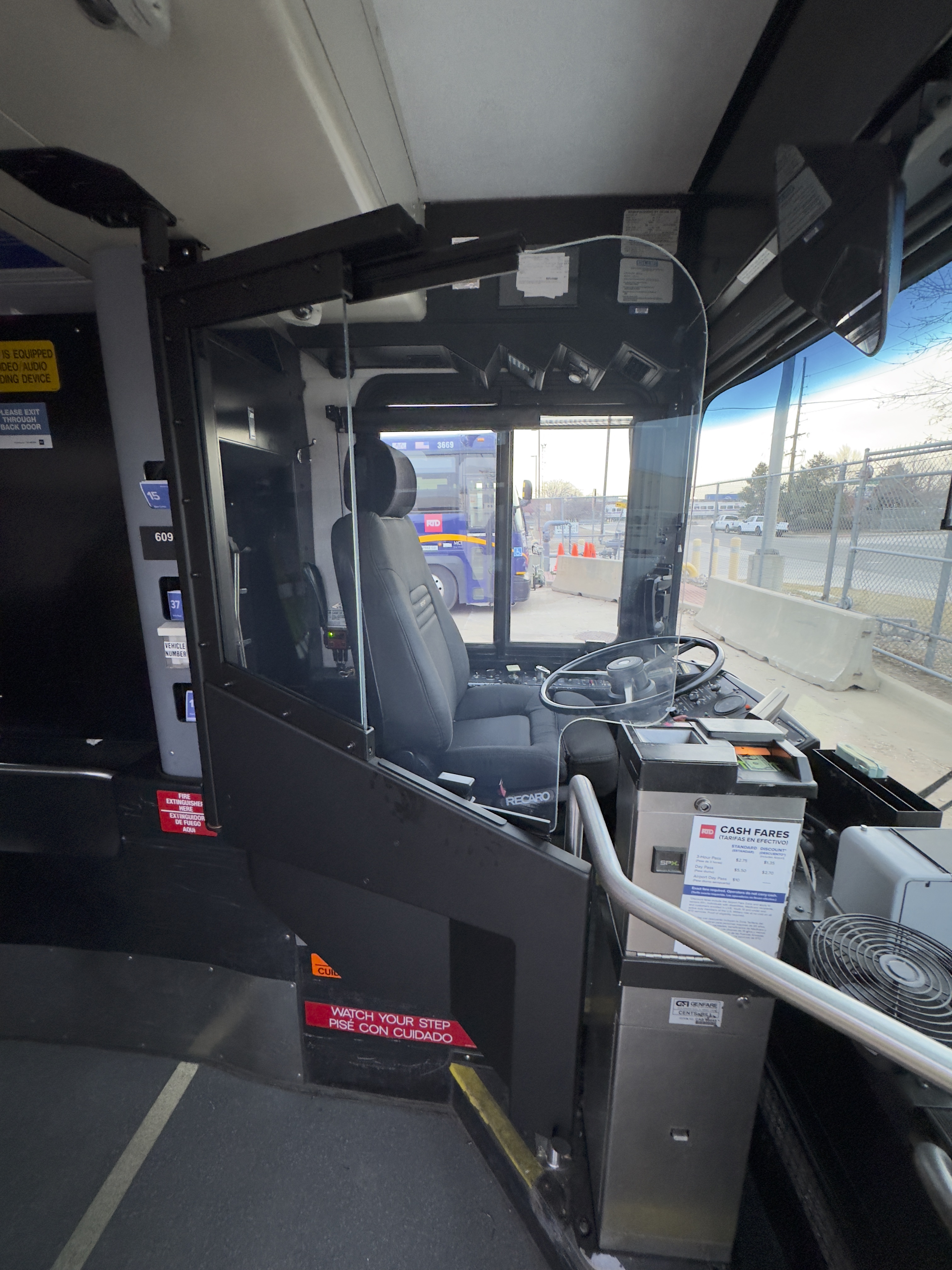
Barrier to entry: new operator shields aim to keep operators safe
2020 changed the world forever. A once-in-a-lifetime global pandemic combined with societal issues hitting flashpoints and a pivotal United States election year led to the creation of a volatile environment for many, including the hundreds of RTD operators still on the road. Quick thinking and rapid adjustments were made to protect operators from COVID-19, the virus that sparked the pandemic. However, with operator assaults on the rise, quick action was needed to make it safer for operators to do their jobs. This understanding has evolved into one of the agency’s largest advancements ever toward operator safety.
Work on a permanent safety barrier solution began shortly after the height of the pandemic. “We had to evolve from a COVID way of thinking into a way of thinking that could better protect drivers,” said Daniel Ortega, a body shop supervisor at District Shops.
Ortega, who oversees a team of mechanics, had an emotional stake in ensuring the agency’s operators were safe both during the height of the COVID-19 pandemic and well after, and they used every possible resource in the body shop to do so.
The project was made a top priority for the agency, with RTD’s Leadership Team expressing support from the start and helping to make sure the funding and resources were in place to begin ordering the shields as soon as possible.
RTD had initially identified two manufacturers who could produce safety shields, AROW Global and Wabtec Bus Solutions’ Vapor system. The agency ultimately moved forward with AROW Global as the supplier and chose their AROWGuard Slide System as the product that would be installed on RTD’s bus fleet due to its simple, intuitive design. Operators could get in and out of their workspaces easily while still receiving maximum protection. This new system, custom-built for the fleet’s different buses, features a two-piece sliding laminated safety glass system reinforced by a steel door. The placement of the shield’s latch-and-lock system behind the door makes it available only to the operator.
New shields are stronger than plexiglass barriers
These upgraded safety shields are a major improvement over the in-house design engineered during the onset of the COVID-19 pandemic to protect operators from customers.
Back then, Ortega said, the question was, “What could we do to protect the drivers that aligned with the Center for Disease Control’s guidelines?”
The solution: plexiglass barriers that separated the operator’s seat from the rest of the bus. The barriers were a quick, inexpensive and effective temporary solution to an evolving pandemic, and they were all fabricated in the agency’s body shop. The entire bus fleet was equipped within a couple of months.
“We can build pretty much anything and everything here at the body shop,” Ortega said. “I have probably the most talented group of guys in the United States. They can fabricate anything with the tools we have here at RTD.”
Installation of new shields began late last year
Unlike the plexiglass barriers, the new safety shields are engineered to withstand punches, kicks and attacks using blunt force objects. In addition, the sliding two-piece glass system allows the operator to extend the safety glass closer to the dash, making it virtually impossible for assailants to reach around it and assault the operator. In the event of an emergency such as a crash or fire, the latch-and-lock system allows for the operator to quickly open the safety shield and exit the bus, while the sliding glass pane provides another exit option in the unlikely event of a door jam.
Another bonus of AROWGuard is the company’s partnership with Gillig, the manufacturer of the majority of RTD’s bus fleet. This fact made retrofitting older buses a much easier process.
Installation of the new safety shields began in late 2023 with a focus on 6000-series buses that operate on routes with higher numbers of operator assaults, including Routes 0 and 15. Each install takes a team of two technicians about four hours to install the safety shield. At this pace, they complete approximately two buses per day.
The next focus is installing the safety shields onto the articulated buses, such as those that operate Routes 0L and 15L. The shields that are being installed on these buses are a bit larger than the ones on the Gillig 40-foot buses. Additionally, contractors will be receiving install kits within the coming weeks so they can begin adding the shields on their buses.
Eric Castillo, Assistant General Superintendent of Bus Maintenance, said the new safety shields have been installed on 128 buses as of Feb. 8, with a goal to complete 250 buses by the end of June. He also noted that 102 new in-service buses came with the shields pre-installed. While the goal is for all buses to have protective barriers, a time frame has not yet been established to reach every vehicle.
“Operating a bus has to be one of the most challenging jobs out there,” Ortega said. “I have the upmost respect for our drivers, and if we can do our little part to increase their safety, it’s a win-win for not just our drivers, but for everyone.”