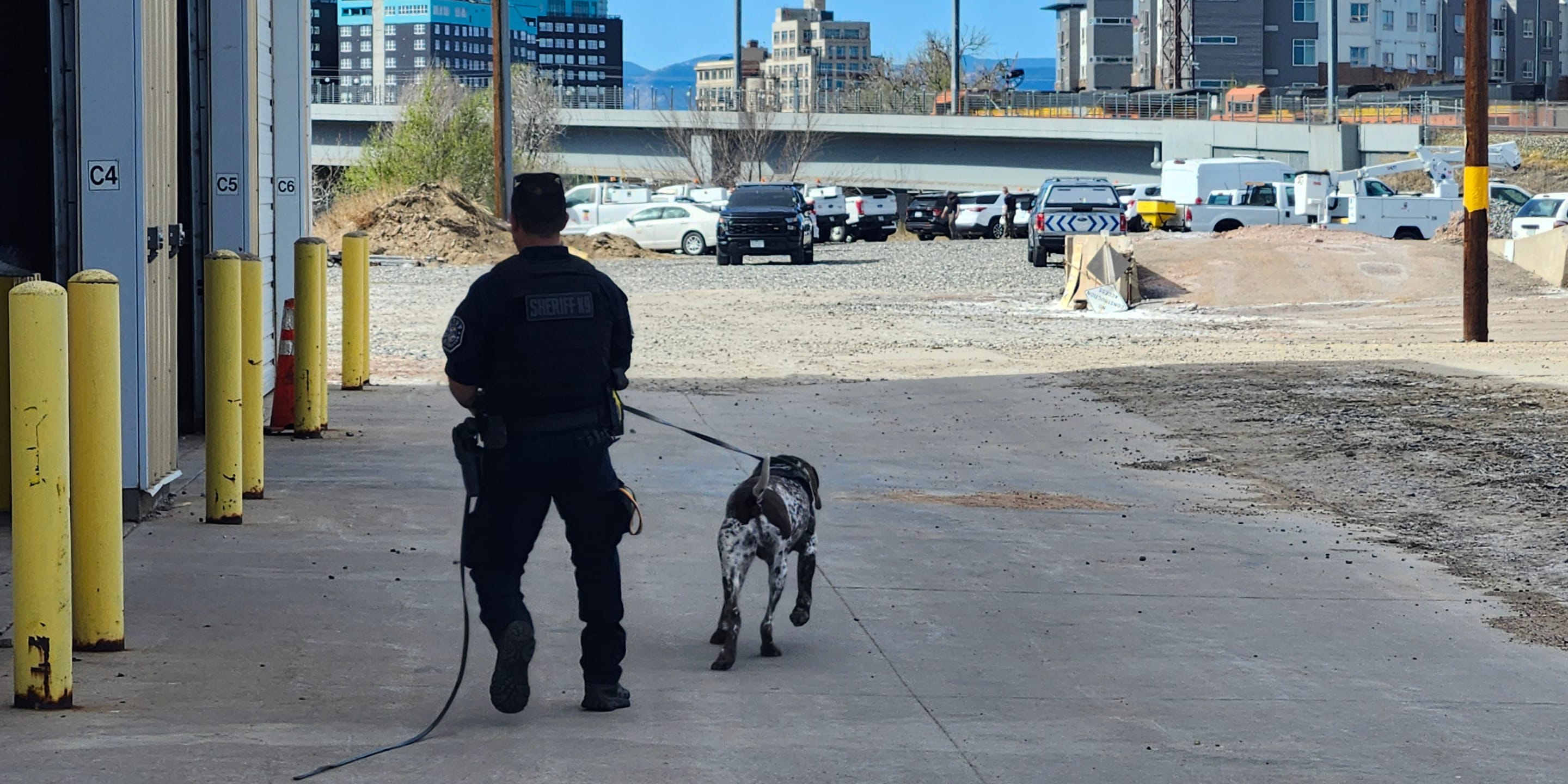
RTD hosted police K-9 training to strengthen public safety
Colorado law enforcement K-9 teams train weekly to build cross-agency partnerships essential for emergency response
RTD Transit Police K-9 handlers hosted a 10-hour training on Wednesday, March 25, as part of an ongoing partnership between law enforcement and military K-9 teams across Colorado. The weekly trainings enable the tightknit community of local, federal, and military K-9 units to strengthen the relationships between agencies for coordinated responses to threats. The training also challenges handlers in working with the dogs so that there are “no bad days” in a real-world event requiring K-9's highly trained detection skills.
RTD officer and K-9 handler Corey Averill emphasized the importance of K-9 teams across Colorado training together as they can be deployed together. “Bomb dogs are a specialized tool, and we usually find ourselves working together on real-world callouts. If we ever had a large-scale incident and needed help, we could call on other agencies to assist, and this gives their dogs exposure to our system.”
Each week the Front Range Explosive Detection (FRED) multi-agency teams from Colorado run through training exercises with the K-9s and their handlers. FRED training rotates around the region with K-9 teams coming together for approximately seven to 10 hours each week. The routine training improves specialized dogs’ and their handlers’ ability to protect the communities they serve and maintain certifications for military, agency, and/or police work.
Averill, who organized Wednesday’s full-day session, noted that the weekly training exercises are more complex than odor detection alone. “It's more than just putting something out and having the dog find it; the overall goal is to build a strong reliable team between the handler and the dog,” Averill explained. “We wanted the handlers to feel confident in their ability to read their dogs when they deploy their dogs in the field.”
The recent training included five exercises based on real-world scenarios to challenge both the handlers and the K-9s. “It helps the dog learn to work through different conditions and helps the handler get better at reading the dog's behavior,” Averill said.
One scenario was set up with multiple vehicles nearby though the explosive was planted elsewhere to challenge a handlers’ ability to trust the K-9's powerful detection skills. “Naturally, the handler may focus on the vehicles, but the goal is to see if they can read their dog instead of just going where they think the problem is,” said Averill. “This helps reinforce that the dog is working odor and not just searching objects.”
Working as a K-9 handler is a 24/7 job as one never knows when they’ll be called to a site for an investigation or threat detection. The dogs’ skills are used for working social events with high volumes of people, protecting individuals, and/or investigating bomb threats or responding to active shooter incidents. Some of the dogs that participated in the exercises also are trained in identifying narcotics or tracking suspects.
Routine K-9 training across agencies enables each to familiarize themselves with other agencies’ teams to facilitate real-world collaboration. Whereas RTD Transit Police K-9 teams regularly patrol the service area vehicles, stations, and buildings, the State Patrol K-9s, for example, are responsible for working at the state capital. Rotating the teams’ training locations weekly enables the specialized dogs to acclimate to other environments so that it is not unique when an incident or threat arises requiring multi-agency response.
Maintaining operational efficiency is another benefit of multi-agency teams partnering together for area clearances. “Additional K-9 teams on site allows for work rotations and keeps operations moving without interruption,” Averill said.
Typically, five-to-ten K-9 teams participate in routine training together providing a learning environment to “make mistakes here, so that we know what to do in live scenarios,” said Denver Sheriff’s Department Officer Brandon Trujillo.
Multi-agency familiarity has already proven valuable. Trujillo added,“We’ve had multiple bomb threats where we’ve assisted different departments because of this group. Training weekly for detection work allows us to get one agency’s dogs on another agency’s odors because no two odors are alike. The training helps us in case we have a bomb threat;we know which dog can work with other K-9s. Some work better alone and other K-9s work great together.”
RTD Transit Police K-9 teams are similarly called upon to assist in the region. “A few months ago, (K-9) Milo and I went out to help Jefferson County and Milo found a firearm that was connected to a homicide investigation,” Averill said.
Police K-9s undergo 10weeks of initial training to achieve a 400-hour certification for detection work and continue weekly training thereafter for the duration of their service.
Colorado-based K-9 instructor Greg Johnson attended the March 25 training session to assist a new K-9 team with another agency’s training. He noted that partner agencies coming together for training enables handlers to identify any needed adjustments. “Some people might pick up different techniques or something with the dog which is better to learn sooner than later. You can’t make sudden changes (with the K-9s),” he said. It is also important to complete training scenarios during different times of day so that the dogs can acclimate to working in varying light conditions.
The K-9s are trained to make a “passive alert” when they detect a threat or evidence and are exuberantly rewarded based on the dog’s preference for a particular toy or even a snack.
In addition to RTD Transit Police, last Wednesday’s training exercise was attended by K-9 units from RTD Transit Police and 10 other agencies including Adams County, Brighton, Chafey County, Commerce City, Colorado State Patrol, Denver Sheriff Department, Jefferson County, the Colorado Office of the Inspector General, and Pueblo County.
RTD Transit Police has four K-9 units to support community safety across its transit system since November 2024. The K-9s “are tremendous for providing RTD with K-9 coverage seven days a week,” said Averill. The K-9 units are part of police patrols across the agency’s 2,345-square-mile district, including transportation hubs such as Denver Union Station, the A Line to the airport, and other commuter and rail lines and buses and stations.
The agency’s Transit Police department and K-9 units were recognized this past January by the Boulder Police Department for their assistance in responding to an investigation immediately following the June 1, 2025 Pearl Street attack.