New year brings revamped command center for police dispatchers
January's move to the updated Security Command Center had been planned for several years and culminates into improved workload collaboration for the agency’s first, first responders
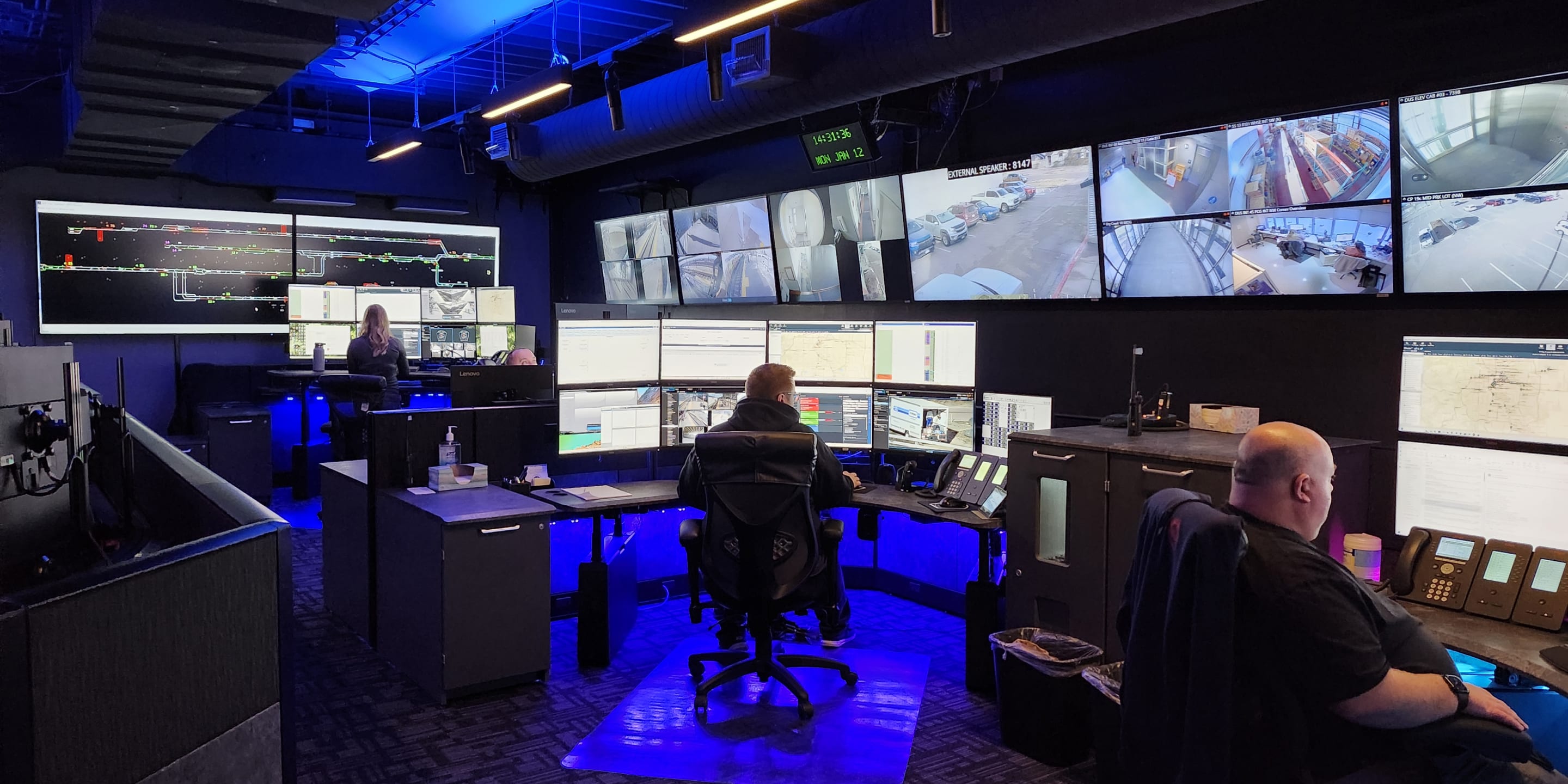
RTD’s Transit Police (RTD-PD) Public Safety dispatchers moved back into the department’s original Security Command Center near the agency’s Mariposa Light Rail Facility on Jan. 7 to consolidate the team and Transit Police Communications’ operations. The return, several years in the making, enables the team to address first-responder communications from across the district from a single RTD operating site. “This project demonstrated the agency’s commitment to OneRTD,” said Michelle Lawrence, RTD Manager, 911 Operations. The return “allows for a shared workload and streamlined response to incidents.”
Lawrence added, “The operational move was a herculean effort requiring significant support from nearly every RTD department. The official go-live at the Security Command Center went seamlessly thanks to the dedication and effort of countless RTD employees.”
Emergency oversight across the entire system
Public safety dispatchers originally consolidated into DTO’s Commuter Rail Maintenance Facility (CRMF) in January 2025 to more effectively address call distributions and workload, with the entire dispatch team fielding 250 calls on average daily.
The facility is held by RTD’s concessionaire, Denver Transit Operators (DTO). The team’s united return to RTD’s Security Command Center still enables dispatchers to answer security-related communications from emergency phones from DTO and RTD sites, including along the A, B, and G lines, maintained by DTO.
A Line opening required two police dispatch locations and two desk phones
Transit Police dispatchers started working from a DTO facility to coincide with the A Line’s opening in 2016 to address any security calls or concerns related to DTO locations. Originally, public safety dispatchers could only answer calls from emergency phones specific to DTO-maintained lines from a DTO facility. This required RTD’s Transit Police dispatchers to work from the Security Command Center and the CRMF. As additional commuter rail lines were added to the rail system, public safety dispatchers picked up fielding communications from these DTO-maintained properties as well.
With the consolidation into CRMF last year, Transit Police dispatchers had two phones on their desks with distinct extensions for DTO and RTD emergency calls. After telephone and system planning updates and integration in December 2025, security calls could be fielded from both security command centers with redundant systems.
OneRTD planning
RTD’s Transit Police Communications team has been planning the team’s return to the Security Command Center since 2022. In advance of the move, the Security Command Center was updated with new workstations featuring eight monitors for each employee. Four additional workstations were added to the Command Center, doubling the number of dispatchers who could work in the facility.
Mike Finnell, RTD Lead Public Safety Dispatcher said returning to the agency’s updated command center “improves efficiency for training new dispatchers and allows for a more professional workspace.” RTD Public Safety Dispatcher Spencer Sedbrook added, “I appreciate the investment RTD has made to our mental and physical health,” with the workspace fitted with additional monitors and adapted for four additional dispatchers to work out of the location.
Monitors along the front and side walls display high-definition video feeds cycling through any RTD facility, stations, and garage throughout the district, such as Denver Union Station, Civic Center Station, and including but not limited to Mineral, Wadsworth, Sheridan, County Line, Colfax, and Oxford stations, for safety and security purposes. Lawrence said, “The live-feed video cycles do not include live look-in cameras on vehicles,” which are viewed when prompted by an operator or customer report.
Lawrence recognized that Transit Police dispatchers’ return to the Security Command Center as one functional team involved coordinated effort across the agency from departments including asset management, procurement, legal, integrated technology systems, integrated security systems, telecommunications, facilities maintenance, technical services, desktop support, and finance.
Public Safety Dispatcher Lane Hines, who has worked as a dispatcher with RTD for almost 10 years, said, “I’ve never held a better job or been on a better team. I like knowing my work has a positive impact and what makes it for me is the team,” he said. “We come from a lot of different backgrounds, some of us are military or law enforcement background; it’s always good to see what different people bring and who is going to have a fresh take on something.”
RTD currently has 17 dispatchers and four lead dispatchers on the Transit Police Communications team who each work 12-hour shifts. The dispatchers provide 24-hour coverage and response as first responders for any security-related calls throughout the 2,345 square-mile area.
The agency plans to hire two additional dispatchers, and two more dispatcher leads to bring the team to its fully budgeted staffing level for 2026.