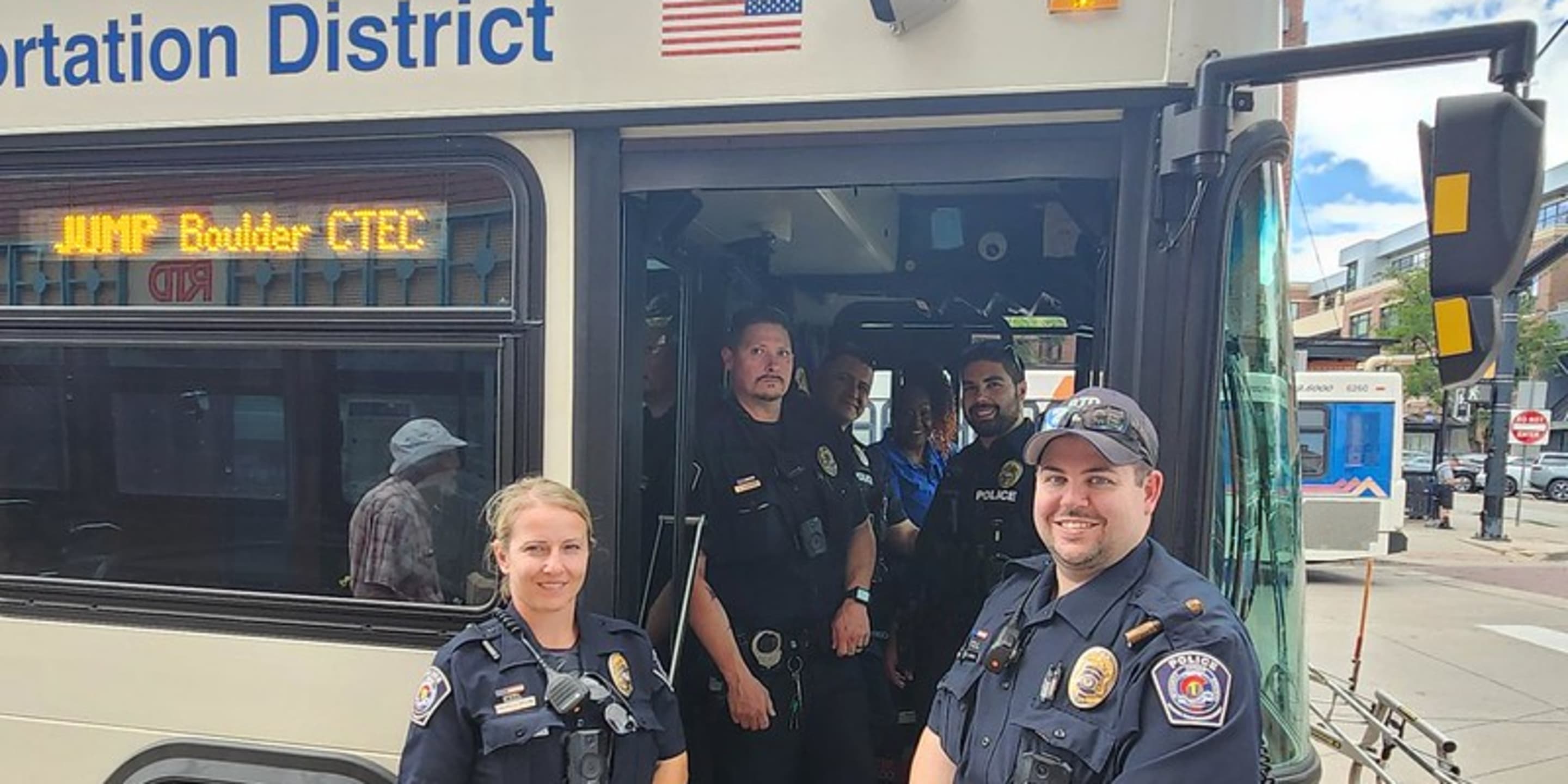
RTD Transit Police names 2025’s Top Five achievements to progress community safety
DENVER (Jan. 5, 2026) –– The Regional Transportation District (RTD) Transit Police (RTD-PD) marked notable achievements in 2025 as part of efforts to reinforce customer and operator safety and promote a Welcoming Transit Environment. While the department made progress in multiple areas, including growing to 105 sworn officers as of December 2025 from 67 in May 2024, providing around the clock patrols, expanding its homelessness outreach program, and increasing the police cadet program to three cadets, the following represent the Top Five achievements for RTD's Transit Police in 2025.
#1 Increased fare checks
The agency has increased fare checks by 500% since May 2024 to ensure individuals on light rail and commuter rail trains are customers who have paid fare to board. Between 300,000 and 400,000 fare checks are conducted each month by Transit Police and security officers on the rail system. Fare checks bring officers in direct contact with customers and improve officer visibility on vehicles and across the transit system. Officers can answer customer questions and share information about the agency’s customer code of conduct – Respect the Ride – to support a welcoming and comfortable travel experience for all customers.
#2 Consistent decreases in security-related calls and illicit drug activity
RTD recorded year-over-year decreases in security-related calls for nearly every month of 2025, with the most recent data available through November. The department saw an overall average 21% decrease through October 2025 when compared with the same time through October 2024. Another consistent trend is an average 57.9% overall decrease in reports of illicit drug activity through October 2025, the latest data available, bringing the total to 15 consecutive months of year-over-year decreases since August 2024.
Related: New webpages share security metrics and tactics
The agency made safety and security metrics available 24/7 with monthly updates on its Security-Related Metrics webpage that launched last year. Metrics shared include the number of systemwide boardings and incidents reported relative to boarding totals, criminal incident reports, arrests, Transit Watch app incident reports, among other information.
RTD also launched a Safety and Security webpage detailing the comprehensive efforts RTD is undertaking to support a Welcoming Transit Environment, noting that most customers complete their travel without incident and with ease.
#3 Launched a fully operational detective bureau
On Oct. 15, the RTD-PD launched its fully operational detective bureau, able to investigate and prosecute crimes, involving any threat or use of force, in multiple jurisdictions across the agency’s district. The effort began in January 2025 and included standing up a property and evidence room to manage intake, storage, and release of property and evidence in accordance with RTD-PD policy. The bureau is comprised of eight RTD-PD employees: a Detective Lieutenant and four detectives, a Victim’s Advocate Program Specialist, an Evidence, Property, and Records Specialist, and a Records Technician. All RTD Transit Police officers are trained on how to properly document and follow procedures for in-custody arrests across all counties where offenders may be booked. The bureau enables RTD to oversee certain types of criminal investigations instead of relying on partner agencies that may be experiencing resource constraints.
#4 Expansion of Customer Experience Elevator Program
Growing from the original three stations as part of a pilot program in 2024, RTD currently has 10 locations programmed to ensure elevators doors remain open when not in use. Data shows that the program significantly reduces security-related calls and maintenance needs at locations where elevators are reprogrammed. The tactic is one part of the agency’s Crime Prevention through Environmental Design – a multi-faceted approach to reducing crime and deterring offenders at stations, stops, and facilities. RTD owns and operates 79 public-facing elevators and will continue to extend the program beyond the 10 locations in 2026. Early findings from RTD’s elevator 2024 pilot program have encouraged other transit agencies to contact RTD-PD to learn about launching similar elevator programs across their transit systems.
#5 Employing virtual reality technology for real-world skills
The Transit Police Department took advantage of virtual reality modules starting in June 2025 for officers to learn how to safely assess a wide range of situations and address threats. The immersive training allows officers to hone their decision-making skills accounting for factors such as the physical or mental state of the individual in a training scenario, down to the details of the clothing a person may be wearing and how that impacts the use of TASER devices. The program supports officers becoming certified to use TASERs, allows the department to directly view an officer’s actions in the simulated environment, and provides access to performance metrics. The system’s headset and tablet device are portable, enabling training to be conducted in many locations. Another benefit is that training is conducted in regular 15-to-20-minute sessions rather than taking officers off their regular work assignments for a training day.
Looking ahead
The community will hear about more measurable progress this year as the Transit Police continues to fulfill its four-step security plan: maintaining a visible presence, using technology to improve safety, conducting routine fare checks, and routinely engaging with customers to ensure a continued positive impact for the metro-area’s transit community and a welcoming transit environment for everyone.