Transit Is Democracy: Honoring Rosa Parks on Transit Equity Day
Transit is democracy. It is how people access opportunity, exercise choice, and participate fully in civic life. When public transportation is affordable, reliable, and accessible, it strengthens communities and supports a more inclusive society. When barriers to transit exist, inequities deepen.
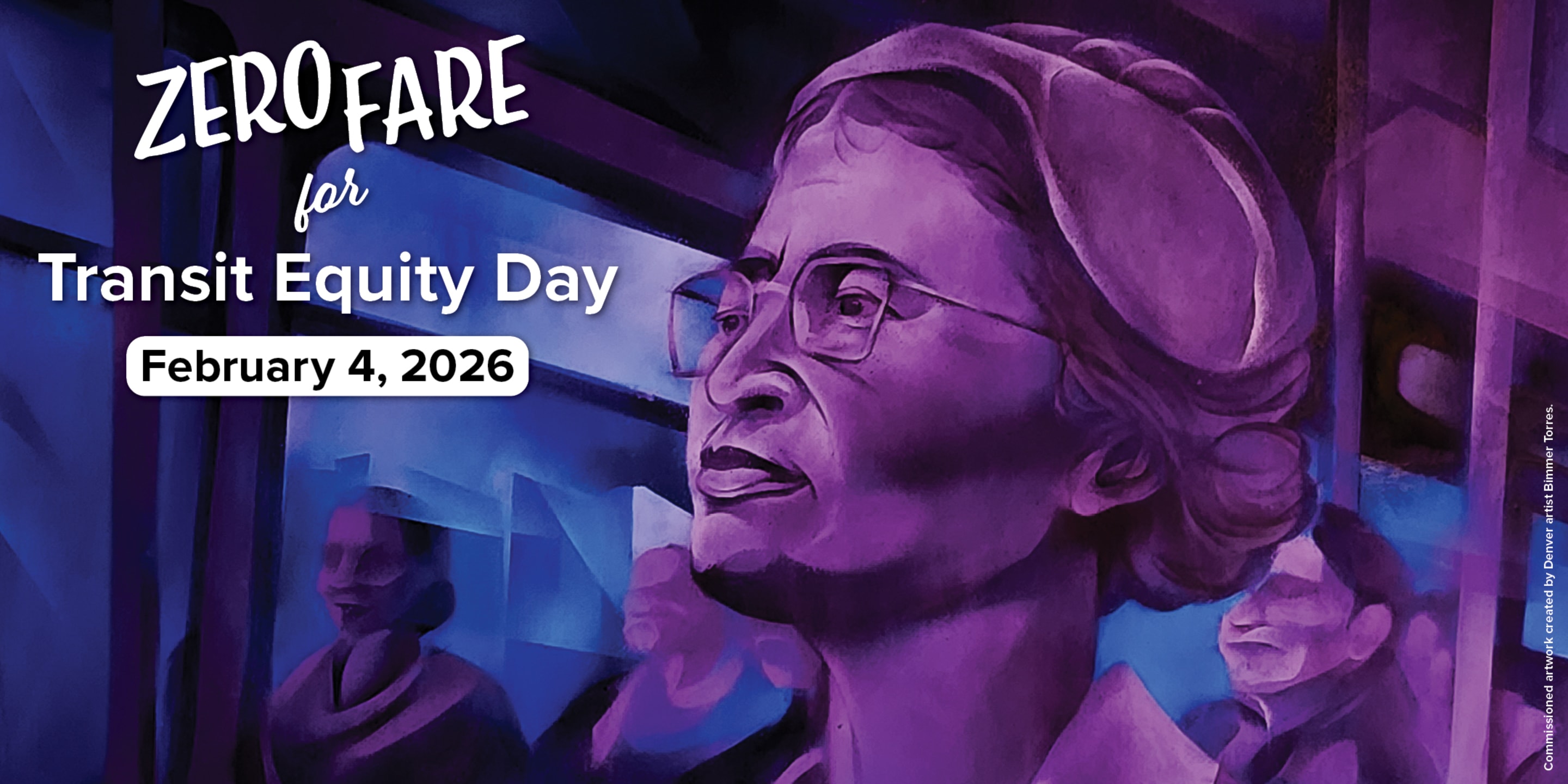
This year’s Transit Equity Day theme — Transit is Democracy — speaks directly to RTD’s approach to provide safe, reliable, equitable, and accessible transportation that connects people to what matters most: jobs, education, health care, family, and community. Public transit is not just about moving people from point A to point B; it is about ensuring everyone has a seat at the table in the region’s economic and civic life. Observed each year on Feb. 4, Transit Equity Day coincides with the birthday of Rosa Parks, whose courage on a public bus helped reshape the nation and cemented transportation as a critical civil rights issue.
A legacy rooted in public transit
Public transportation has long reflected both the promise and the contradictions of democracy. In the segregated South, buses were everyday spaces where racial injustice was enforced through law and customs. For Black riders, transit was not only a necessity, but also a daily reminder of exclusion, limited access, and unequal treatment.
On Dec. 1, 1955, Rosa Parks challenged that system when she refused to give up her seat on a Montgomery, Alabama, bus. Her decision was deliberate and courageous. Parks, a longtime civil rights advocate, understood the risks of resisting segregation. Her arrest sparked the Montgomery Bus Boycott, a sustained, community-led effort that demonstrated the collective power of everyday riders. For more than a year, Black residents organized carpools, walked miles to work, and stood together to demand dignity and fairness. The boycott ultimately led to a U.S. Supreme Court ruling that ended bus segregation, marking a pivotal moment in the Civil Rights Movement.
Equally important is the story of Claudette Colvin, who, at just 15 years old, took a similar stand months earlier. When asked to surrender her seat, Colvin refused — drawing strength from her belief in constitutional rights and equality. While her actions did not immediately receive public recognition, her role proved critical. Colvin later became a key plaintiff in Browder v. Gayle, the federal court case that challenged Montgomery’s segregated bus laws. Her testimony helped secure the legal decision that ultimately declared bus segregation unconstitutional. Following her passing on Jan. 13, 2026, we honor Claudette Colvin not only for her role in history, but also for the enduring impact of her courage. Her story is a powerful reminder that young people, everyday customers, and those whose contributions may not always receive immediate recognition are often central to lasting change.
Together, the legacies of Claudette Colvin and Rosa Parks remind us that public transit has long been both a site of injustice and a catalyst for progress — and that democracy is shaped by individuals who choose to stand, or remain seated, in pursuit of dignity and equity for all.
The National Transit Equity Day movement
Transit Equity Day is part of a national movement grounded in the belief that mobility is a civil right — and that public transportation must advance equity, access, and opportunity for all. While advocates and organizations had long observed Rosa Parks’ birthday as a moment to honor transit justice, the movement gained formal national recognition in 2021 when the U.S. Department of Transportation officially celebrated Transit Equity Day for the first time. This milestone elevated the importance of equitable transportation at the federal level and helped inspire broader adoption by public agencies across the country.
Since that first federal observance, dozens of public transit agencies and local governments nationwide have recognized Transit Equity Day — marking the occasion through zero-fare initiatives, symbolic recognitions, educational campaigns, and community partnerships. These efforts reflect a growing shared understanding that transportation equity is foundational to community well-being and civic participation.
Transit Equity Day intentionally links the legacy of the Civil Rights Movement to the ongoing work of making transit more just and inclusive. It calls on transit agencies, policymakers, customers, and communities to consider how transportation decisions shape access to jobs, education, health care, housing, and civic life — and how inequities in service and investment can limit opportunity.
The movement underscores that:
- Public transit supports civic participation by connecting customers to voting locations, community meetings, schools, and public services.
- Reliable and affordable service expands economic opportunity, reducing transportation costs that disproportionately impact low-income households.
- Accessible systems promote dignity and independence, ensuring customers with disabilities, older adults, and caregivers can travel safely and confidently.
- Equitable transit planning helps address historic disparities, particularly in communities that have experienced long-standing disinvestment or exclusion.
More than a commemoration, Transit Equity Day serves as a call to action — a reminder that how people move through their communities directly influences who can access opportunities and participate fully in civic life. As transit agencies nationwide continue to recognize the day, they reinforce the essential role public transportation plays in shaping a more equitable and inclusive society.
RTD’s commitment to transit equity
RTD is proud to honor Transit Equity Day through both symbolic recognition and sustained, meaningful action — reflecting an ongoing commitment to equity, accessibility, and inclusion across the region RTD serves. Grounded in the belief that public transportation is a public good, RTD continues to advance initiatives that reduce barriers, expand access, and affirm the dignity of every customer.
Commemorative “In Honor of Rosa” signage
On Feb. 4, customers will see commemorative “In Honor of Rosa” signage on select seats aboard RTD buses, honoring Rosa Parks. These seats are not reserved or enforced and remain open to everyone.
The signage is intended to invite reflection and learning—acknowledging Parks’ legacy and recognizing public transit as a powerful public space where civil rights were challenged and advanced. It serves as a visible reminder that everyday transit moments can inspire conversation, education, and a shared sense of responsibility toward equity and inclusion.
Zero Fare for Transit Equity Day — A permanent annual initiative
RTD observes Transit Equity Day with zero fares on all services on Feb. 4. This includes bus, rail, Access-a-Ride, FlexRide, and Access-on-Demand (AoD). For Access-on-Demand, the RTD fare is waived for Transit Equity Day, and customers will only be responsible for payment if a trip exceeds the AoD subsidy amount. RTD has approved Zero Fare for Transit Equity Day as a permanent annual initiative, ensuring customers can rely on zero-fare service every year on this date. By removing cost as a barrier, RTD reinforces the principle that access matters — and that public transit should connect people to opportunity without undue burden.
Together, these efforts reflect RTD’s commitment to putting equity into practice. Symbolic recognition honors the past and educates the present, while zero-fare access delivers tangible impact — helping customers reach jobs, school, health care, and community on a day dedicated to equity in transportation.
As RTD continues this annual observance, the agency remains guided by its core values — working with passion, respect, and accountability to deliver equitable, trustworthy transit that connects people to opportunity.
Celebrating Transit Equity Day with RTD
Below are ways to engage on Feb. 4:
Zero Fare for Transit Equity Day | Feb.4 |All RTD bus and rail services will be zero fare for customers throughout the day, reinforcing RTD’s commitment to accessibility and equity in public transportation. This permanent annual initiative honors Rosa Parks’ legacy and underscores the vital connection between public transit access and civil rights.
Honor Rosa Parks: Share the Moment | Feb. 4 | Customers are invited to pause at the commemorative “In Honor of Rosa” signage onboard RTD buses, take a photo, and share it on social media to honor Rosa Parks’ legacy. By sharing reflections, photos, or moments from their ride, customers can help elevate the message that public transit is a shared civic space rooted in dignity, access, and belonging. (Participation is optional, and signage is symbolic and open to all.)
Labor Network for Sustainability: Transit Equity Day 2026 | 10 a.m. Feb. 4 | This national livestream will feature transit labor union members, climate organizers, and community stakeholders in conversation about advancing affordable, equitable, and publicly operated transportation systems. The event highlights the continued role of collaboration and advocacy in building a more just and sustainable transit future.
Why Transit Equity Day matters at RTD
Transit Equity Day aligns closely with RTD’s values and long-term vision. By centering equity, accessibility, and community connection, RTD works to ensure that the system supports opportunity for all — especially those who rely on transit most.
Public transportation is a public good. It connects people to possibility, strengthens our region, and serves as a foundation of a healthy democracy.
On Feb 4, customers and community are invited to ride, reflect, and recognize that transit is democracy — and everyone belongs on board.