Americans with Disabilities Act Office
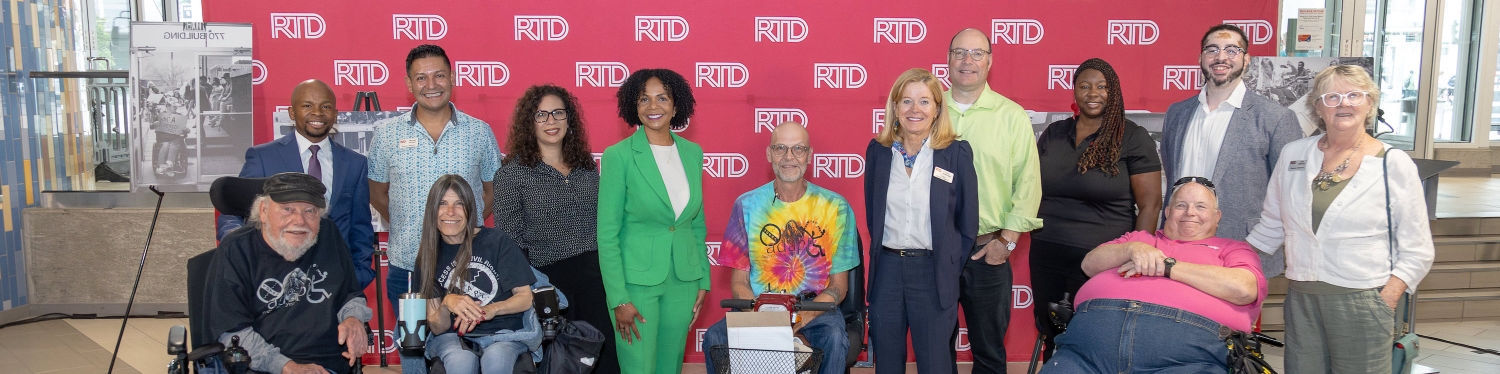
Americans with Disabilities Act Office
The Americans with Disabilities Act Office (ADAO) oversees RTD's compliance with Titles II and III of the ADA, which prohibit discrimination based on disability and require RTD to make the agency’s public transportation system accessible to persons with disabilities. The ADAO oversees compliance with Title II and III of the ADA by managing the reasonable modification process; monitoring agency services and programs to safeguard compliance with federal standards; investigating disability-related complaints; and providing guidance on policies, procedures, and strategies to protect the civil rights of people with disabilities.
Complaint Processing and Appeals
Under Title II of the Americans with Disabilities Act, RTD is required to make its services and programs accessible to people with disabilities and in compliance with the ADA. The following procedure satisfies RTD’s obligation to provide a grievance procedure under Title II. Any person who believes that they have been discriminated against on the basis of disability by RTD may file a disability-related complaint by submitting a complaint to RTD Customer Care. RTD Customer Care is the point of contact for all RTD comments and complaints.
If you feel that you have not been able to access a program or service of RTD because of accessibility issues, or have been discriminated against based on your disability, you may submit a disability-related complaint to RTD Customer Care.
Please submit your complaint to RTD Customer Care by completing RTD's complaint form or call 303-299-6000 [TTY: Dial 711]. Language assistance is available at no cost. For Spanish, please press 2. For all other languages, press 8.
Please be sure to communicate whether your complaint is related to your disability and provide sufficient facts demonstrating how your complaint is related to your disability. You will receive an automatic acknowledgment of receipt within three business days, provided an email address was submitted.
This procedure satisfies RTD’s obligation to provide a grievance procedure under Title II.
Complaint Appeals
If you are dissatisfied with the result of your ADA complaint, you may submit your appeal to RTD’s ADA Manager by completing this online fillable appeals form.
Appeals must be submitted within 30 calendar days of the complaint's submission or 30 calendar days after the customer has received the results of their complaint, whichever is later. The appeal must be provided in text and state all facts and arguments supporting your belief that the complaint was not appropriately resolved. The ADA Manager will review the complaint and provide a written response within 30 calendar days.
For an alternative format to file your ADA Appeal, please contact the ADAO at [email protected]. RTD will retain your complaint, appeal, and response for at least one year.
For organizations or businesses outside RTD’s scope of responsibility, please contact the U.S. Department of Justice at 1-800-514-0301.
Effective Communication
RTD will take appropriate steps to ensure effective communication with applicants, participants, and members of the public with disabilities. RTD shall provide appropriate auxiliary aids and services, where necessary, to afford a person with a disability an equal opportunity to participate in RTD programs and services.
Request for Information in Alternative Formats
If you cannot access the information in a document because of its format, RTD will take the appropriate steps to ensure communication with applicants, participants, and members of the public with disabilities is effective. RTD shall provide appropriate auxiliary aids and services, where necessary, to afford a person with a disability an equal opportunity to participate in RTD programs and services.
To help RTD respond most effectively, please include the nature of your accessibility concern, the format in which you prefer to receive the requested material, the web page address of the material, and the best method to provide the material. Please contact the ADAO at [email protected] , with your request and allow a minimum of three business days’ notice for arrangements to be made.
Reasonable Modifications
In accordance with the ADA and directives from the Federal Transit Administration, RTD will make every effort, to the maximum extent feasible, to ensure that a person with a disability has access to and benefits from RTD services. RTD will make reasonable modifications to its policies, programs, and procedures applicable to its transportation services, when necessary, to avoid discrimination and ensure accessibility for people with disabilities.
Please note: RTD may be unable to accommodate requests that would require fundamental alterations to the nature of RTD programs or services or would directly interfere with the health and safety of others. If the requested modification cannot be granted, but a barrier to access still exists, RTD will do its best to provide alternate access to our programs or services.
If you experience a barrier to accessing an RTD program or service, you may submit a request for a reasonable modification. The request must identify the modification needed to use the service. Whenever feasible, please submit the request in advance, before the modification is needed to access RTD service. Within the scope of the ADA and reasonable modification, if RTD denies a modification request, it will make every effort, to the maximum extent feasible, to ensure that a person with a disability has access to, and benefits from, its services.
To request reasonable modifications based on a disability, please use the Reasonable Modification Request Form, or leave a voicemail with the ADA Office for assistance.
Phone: 303-299-2250 or email: [email protected].
Here is what you should expect when you submit an advanced reasonable modification request with RTD:
- RTD will promptly and thoroughly review your request.
- Please allow at least five (5) to seven (7) business days to receive a response regarding your reasonable modification request.
- RTD staff will be in contact with you if any additional documentation is required or if there is an update about your reasonable modification request.
Related Articles
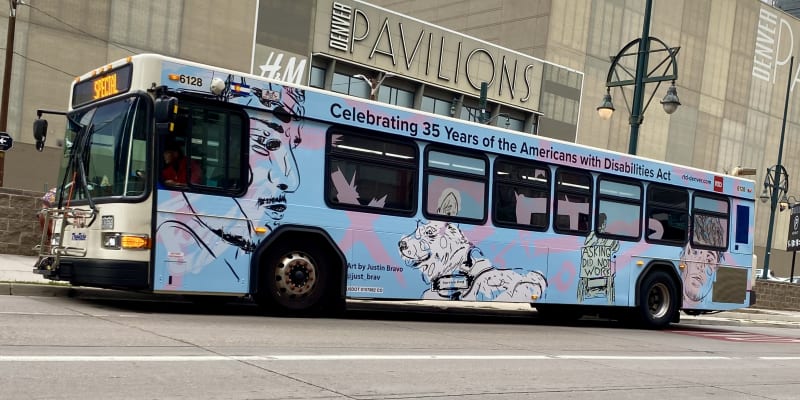
RTD to host 35th anniversary event celebrating the Americans with Disabilities Act
Community event to honor ADA’s legacy and RTD’s continued commitment to accessible, inclusive transit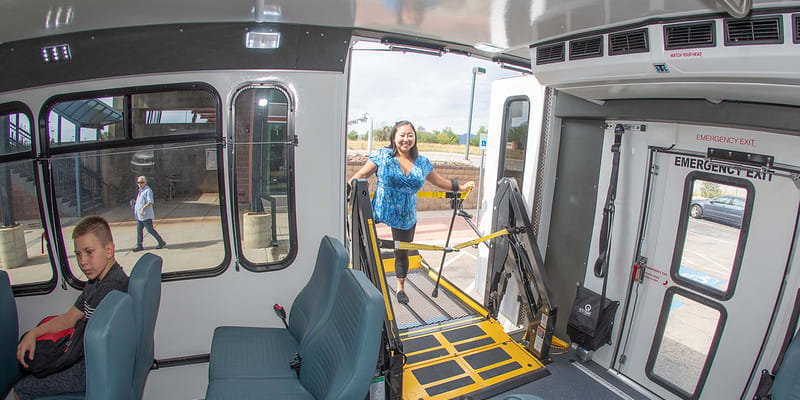
Customer Access and Accessibility Engagement Survey available through Feb. 28
Customers with disabilities are invited to complete a survey to assist RTD in providing more accessible service for customersAccessibility Information
On-the-Spot Modifications
Per FTA Regulations the following two examples are plausible reasonable modification requests.
Obstructions
For fixed-route services, a passenger's request for a driver to position the vehicle to avoid obstructions to the passenger's ability to enter or leave the vehicle at a designated stop location, such as parked cars, snowbanks, and construction, should be granted so long as positioning the vehicle to avoid the obstruction does not pose a direct threat. To be granted, such a request should result in the vehicle stopping in reasonably close proximity to the designated stop location. Transportation entities are not required to pick up passengers with disabilities at non-designated locations. Fixed route operators would not have to establish flag stop or route-deviation policies, as these would be fundamental alterations to a fixed route system rather than reasonable modifications of a system. Likewise, subject to the limitations discussed in the introduction to this appendix, paratransit operators should be flexible in establishing pick up and drop off points to avoid obstructions.
Fare Handling
A passenger's request for transit personnel (e.g., the driver, station attendant) to handle the fare media when the passenger with a disability cannot pay the fare by the generally established means should be granted on fixed route or paratransit service (e.g., in a situation where a bus passenger cannot reach or insert a fare into the fare box). Transit personnel are not required to reach into pockets or backpacks in order to extract the fare media.
Appeal Process for an ADA Complaint
If you are dissatisfied with the result of your ADA complaint, you may submit your appeal to RTD’s ADA Manager by completing this online fillable appeals form. You must submit an appeal within 30 calendar days after you received your results or after you originally submitted your complaint, whichever is later. The appeal must be in writing and state all facts and arguments supporting your belief that the complaint was not appropriately resolved. The ADA Manager will review the complaint and provide a written response within 30 calendar days.
For an alternative format to file your ADA Appeal, please contact the ADA Manager, Gabe Christie at [email protected]. RTD will retain your complaint, appeal and response for at least one year.
For organizations or businesses outside RTD’s responsibility please contact the U.S. Department of Justice at 1-800-514-0301.
Accessible Facilities
All RTD Park-N-Rides locations and stations are ADA accessible. Elevators are present where necessary, as well as ramps to reach boarding platforms, truncated domes for safety, accessible parking spaces and curb cuts. RTD Ticket Vending Machines (TVMs) and validators contain braille and have audible announcements.
In the event of an elevator outage, information will be posted online under Service Alerts and at stations. Passengers can sign up to receive email notifications of these outages at the service alerts page.
Use of Accessibility Equipment
Every customer has the right to use accessibility equipment at RTD stations and on vehicles. Including, but not limited to:
- Ramps, bridge plate, and lifts
- Elevators and escalators
- Accessible gates