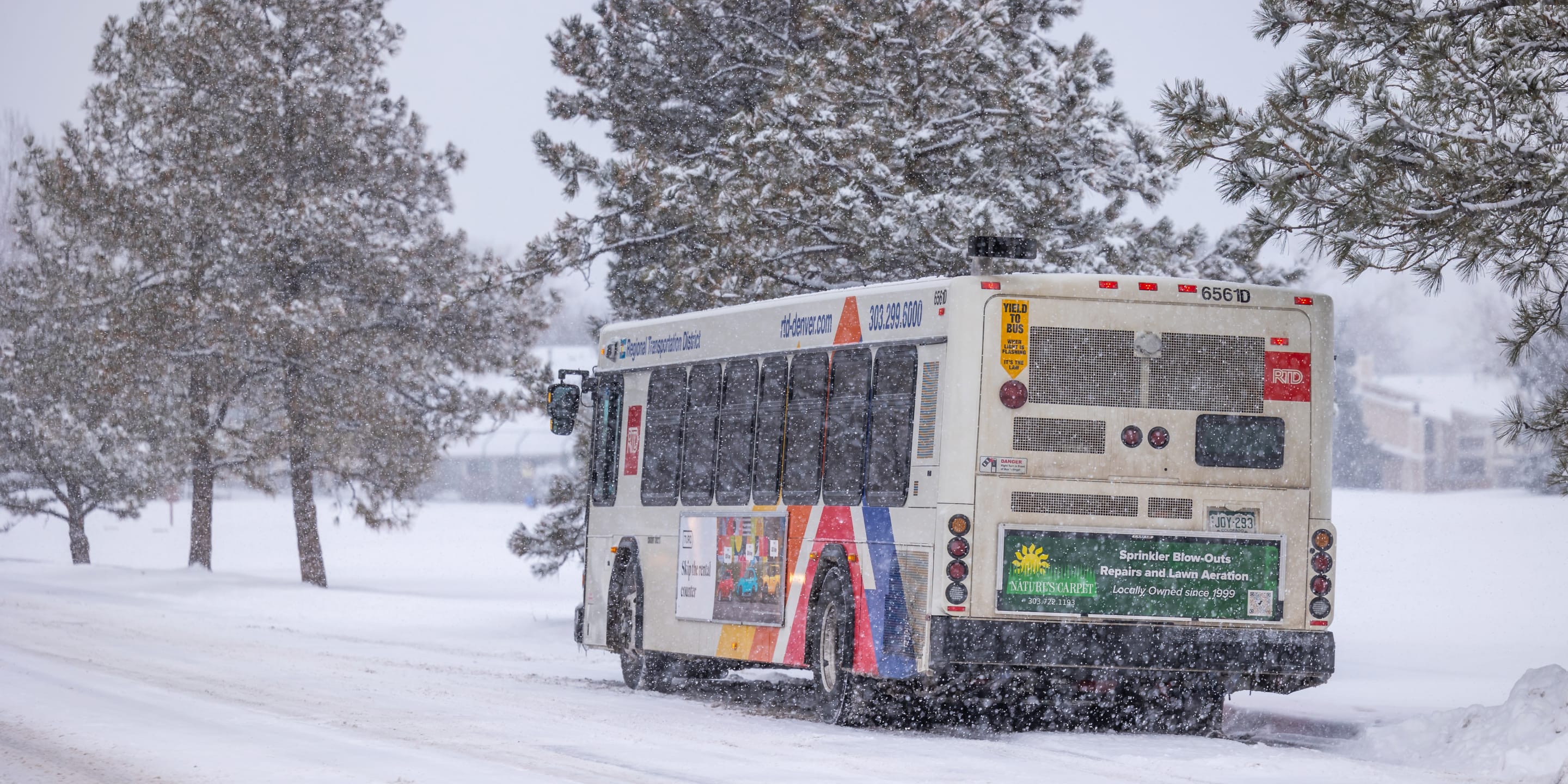
Inside the Snow Desk: RTD’s team that keeps buses moving during winter storms
When winter weather hits Denver, most people notice icy roads, snow piling up on the sidewalks, or the cold wind at the bus stop. What they don’t see is the storm unfolding inside RTD’s Dispatch, where Street Operations works around the clock to keep the system moving. For Tim Lucero, RTD’s General Superintendent of Street Operations, the work begins long before the first snowflake hits the ground.
That preparation and monitoring are critical during snow events, when the entire operation shifts into a coordinated system centered around something most customers have never heard of: the Snow Desk. The Snow Desk is a fully equipped command point that RTD activates when it appears winter weather can start affecting service. As Lucero described it, “We monitor areas with three computers and five monitors… the dispatch and maintenance teams can track the buses, they can see where all their mechanics are at.”
When the Snow Desk is activated, Bus Maintenance team members take control of bus recovery. Their job is to locate stuck buses, deploy recovery teams, and prevent the system from backing up and affecting service across the RTD service area. What starts as a vacant workstation in an already busy division becomes the heart of winter operations.
“We don’t wait for the snow to show up,” Lucero said. “We prepare well in advance. When a bus leaves the garage, we take care of them, we make sure they’re doing what they’re supposed to do, and we help them with any incidents that may arise.”
Activation follows a strict threshold. When dispatchers and street supervisors identify the need for activation, they call Lucero, who asks one question: “How many buses are stuck?” Five is the trigger point.
Activating the snow desk helps the agency manage winter driving during poor conditions and avoid shutdowns on the system. Without the Snow Desk, a single stranded bus could block a major route and impact customers’ journeys. The Snow Desk helps stop a domino effect of impairments across the system, limiting impacts to customers throughout the RTD service area.
Recovery teams have tools that street supervisors cannot carry themselves. They use equipment that lowers buses for traction, tow hooks, and heavy-duty gear designed to rescue buses that are trapped in snow or ice. “My team is out there with shovels and salt, but there is only so much we can do without the tools and equipment of the recovery teams,” Lucero explained. The Snow Desk ensures the right people and the right equipment reach the right buses fast.
When buses start to become stuck, priorities shift. “Customers are number one. If the bus has customers, we’re looking at it,” Lucero said. Routes that run once an hour take priority over those running every 10 minutes. Mountain and rural routes also get bumped up because they are harder to reach and customers often have fewer alternatives.
But even the best planning can hit a snag. In 24 years, Lucero can recall only two times when RTD had to shut down bus service entirely. “Once, the weather was so bad that we finally called it,” he said. “We just had so many stuck buses that we actually started sending supervisors out to pick up the operators who were stranded.” In one case, a bus remained stuck for so long that a nearby resident invited the operator inside their home, where he stayed for several hours before help could reach him.
While critical, the Snow Desk is just one component of a much larger winter effort. Long before storms arrive, the Bus Operator Training team provides refresher courses on winter driving training and chain installation for operators. Bus Maintenance builds recovery schedules and on-call rotations. Facility Maintenance coordinates plowing, traction material, and contractor support. RTD also works with the City and County of Denver, the Downtown Denver Partnership, and the Denver Business Improvement District, among other agencies as part of what they have dubbed the Snow Fighter Committee.
Because downtown Denver is divided into multiple maintenance zones, a stuck bus can physically sit across multiple areas of responsibility at once. Lucero laughed remembering one such case: “One half of the bus was in one section and the other half in the other. It belonged to two agencies. Whoever gets there first will take care of it.”
Getting staff to work becomes part of the storm response. “We will have people that can’t get in because of the weather where they live,” Lucero said. “If they call for help, we’ll go pick them up and get them going.” Snow Desk operations happen no matter the hour, though most often in the middle of the night, while the storm is still building.
After the roads clear, the review begins. The team analyzes the storm and their response, noting what worked, what didn’t, and what needs to change. The Snow Desk has existed for decades, and its value only increases as RTD's system expands. “I’ve been at RTD for 24 years,” Lucero said. “The Snow Desk has been around since I’ve been around, and longer. It’s such an essential part of the job, I could not imagine working without it.”
Most customers will never see the computers, frantic employees from various departments, radio traffic, maps, tow requests, or overnight digging. What they see is a bus arriving in the middle of a snowstorm ready to take them to their destination. The Snow Desk exists so winter storms don’t become winter shutdowns.
Lucero summed up the purpose of the Snow Desk simply: “Keep people safe, keep buses moving, and keep this region connected. Our jobs keep going no matter what the weather is.”
And thanks to the Snow Desk, that mission begins long before the snow starts to fall.