When the bus stop is a block away, the choice gets easier
How one Denver resident moved from biking to transit and found a new routine that stuck
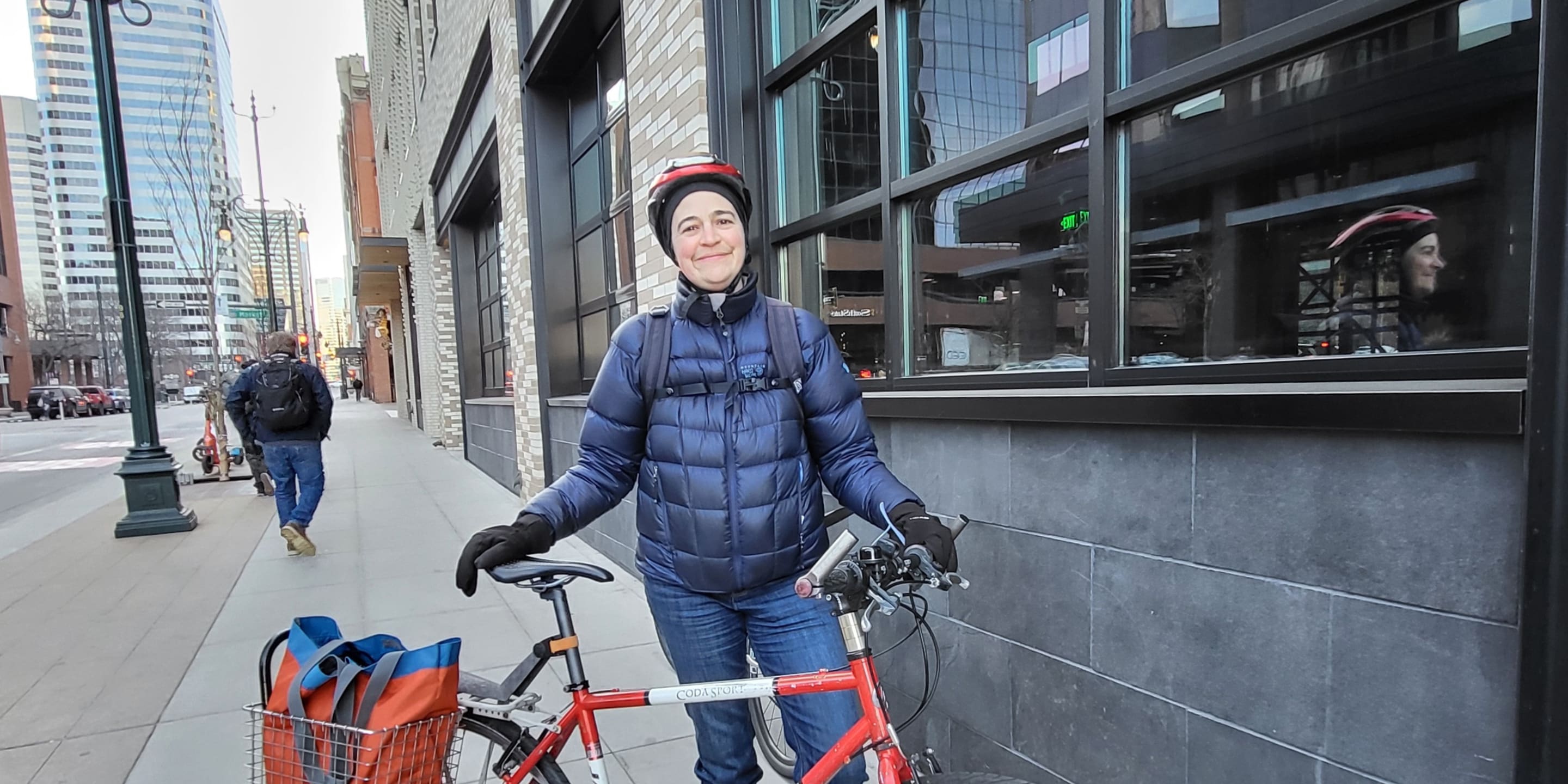
On most weekday mornings, Denee Janda leaves her home and walks about a block to catch Route 38 toward CU Denver's campus, where she works as the director of University Advising helping college students figure out what comes next. But a few years ago, that routine looked different. She measured her days in bike miles, riding through the same streets in all seasons.
“I’d been a bike commuter for years and years,” she said.
When Denee first used RTD, it was part of a longer sequence of tasks: ride to the station, catch a bus, and ride again on the other end. Transit filled the gaps, until the gaps got bigger. In 2019, she moved to Denver but kept her job in Boulder, turning the FF2 between Union Station and campus into a regular commute.
Then her commute had a change of course. By 2022, she had landed at CU Denver and was back to relying almost entirely on her bike.
“I decided I just couldn’t handle the cold on my bike anymore,” she said. “I was just sick of being cold.”
She looked for options closer to home, starting just outside her door.
“I realized that the (Route) 38 is literally a block from my house,” she said. “The (Route) 43 picks up just a little bit farther away.”
Denee found two routes. One ran every 30 minutes, and the other closer to every 15. That was enough to give it a try.
“I told myself it was just going to be through the winter,” she said.
It wasn’t.
“Honestly, now I just ride the bus exclusively to work."
These days, Denee's routine starts with a walk, sometimes just a block, other times a little farther to catch a different route or a better-timed bus.
“I do a ton of walking,” she said. “I’ll walk between stops, and then I take it the rest of the way.”
Her bike is still around, just in a different role.
“I don’t bike a ton these days,” she said. “Maybe more of a once-a-month sort of a thing.”
Now it's more for the occasional weekend ride to a restaurant, a brewery, or Bike to Work Day. But the daily grind belongs to the bus.
“When you’re sitting on a bus or on a train, you’re not the one who has to navigate an accident or the bad roads or whatever it is,” she said. “You just get to sit there and relax.”
Sometimes she catches up on work or an audiobook. Sometimes it’s just looking out the window. Over time, what once felt foreign became familiar.
“I know all the various buses or light rails that I can take and then hop on whichever one is most convenient based on where I am,” she said.
That routine also includes mixing in rail when it makes sense, whether it's a short trip downtown or heading to Denver International Airport.
“I talk regularly about the ease of taking the A Line out to the airport,” she said. “To be dropped off right there is pretty glorious.”
Her husband, a dedicated bike commuter, prefers being on his own schedule. One night, a train pulled up right in front of them, and Denee convinced him to give it a shot.
“When it’s right here, it sure is easy,” she said.
They rode a few stops, got off, and kept moving. No big moment, just a small shift. Those are the moments she notices now. Because in a large city, transit offers something consistent.
“I find the buses to be a great way to see people in my community,” she said. “Just to recognize bus drivers day after day, I love that.”
It wasn't something she expected. Early on, the system felt uncertain, like it does for a lot of beginners.
“The first time you do it, you might just have a little bit of anxiety,” she said. “Like, how do I purchase my fare? How do I show my fare?”
Now, the decision is simple. If the bus is nearby and heading in the right direction, she takes it.
“You’ll probably feel better the second time and definitely better the 10th time that you do a thing,” she said.
Somewhere along the way, the routine settled in. The routes became familiar, and she knew what to expect. What started as a way to get through winter stuck. In the end, the bus was just the easier choice.