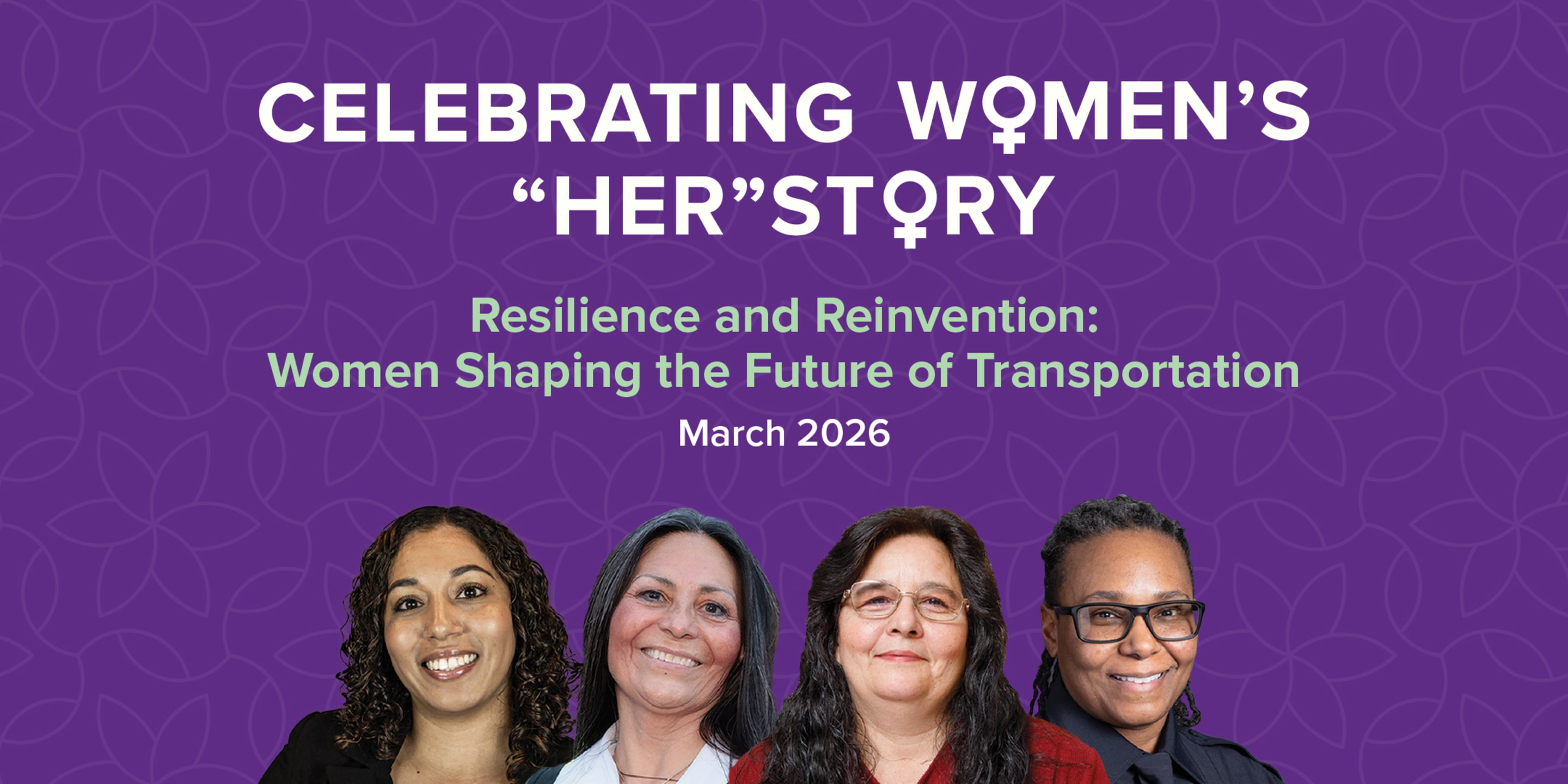
Women’s History Month: Resilience and Reinvention — Women Shaping the Future of Transportation
Women’s History Month traces its roots to the broader women’s rights movements of the 19th and 20th centuries, which advanced voting rights, workplace protections, educational access, and civil liberties. For generations, women shaped public institutions and civic life, often without formal recognition in historical narratives.
The modern observance began in 1978 as a local celebration in Santa Rosa, California, aligned with International Women’s Day on March 8. In 1980, President Jimmy Carter issued the first presidential proclamation declaring National Women’s History Week. By 1987, Congress officially designated March as Women’s History Month, creating a national opportunity to recognize and elevate women’s leadership and impact across sectors.
Transportation occupies a distinct place within this history. During World War II, women entered operational and maintenance roles to sustain public transit systems. In the mid-20th century, public transportation became central to the Civil Rights Movement, as leaders such as Rosa Parks demonstrated that transit systems are not merely infrastructure but platforms for equity, dignity, and access. Today, public transportation continues to connect communities to employment, health care, education, and economic opportunities.
The 2026 national theme, “Leading the Change: Women Shaping a Sustainable Future,” underscores sustainability as both environmental stewardship and institutional resilience. At RTD, the 2026 internal theme, “Resilience and Reinvention,” reflects how women across the agency navigate change while advancing equity, strengthening systems, and sustaining community trust.
Resilience within public institutions is not defined solely by endurance. It is demonstrated through adaptation, strategic growth, and intentional reinvention. This Women’s History Month, RTD highlights three professionals whose journeys reflect these principles in practice.
Spotlight honorees
Kris Horton, HRIS Administrator, Total Rewards and Human Resources
Kris Horton’s professional journey exemplifies reinvention rooted in courage, adaptability, and intellectual curiosity. After 13 years in the aviation industry, she made the deliberate decision to pivot her career and relocate to Denver in pursuit of new professional growth. She joined RTD as a contractor in November 2024 and transitioned to a permanent employee role in September 2025, reflecting both her commitment to the agency’s mission and her ability to navigate complex change with confidence.
Horton’s approach to resilience centers on embracing uncertainty as an opportunity for development. Rather than resisting change, she actively engages in learning new systems, building cross-functional partnerships, and strengthening operational processes. In her role within Total Rewards and Human Resources, she collaborates closely with Talent Acquisition, Enterprise Resource Planning (ERP), Security, Finance, and Information Technology to maintain and enhance the systems that support onboarding, payroll administration, benefits management, compliance tracking, and workforce analytics.
Her work directly influences the employee lifecycle and the structural integrity of RTD’s workforce infrastructure. By ensuring that internal systems are accurate, efficient, and aligned with regulatory standards, Horton contributes to organizational stability and long-term sustainability. Her leadership demonstrates that resilience within institutional systems is built through continuous learning, collaboration, and proactive problem-solving.
Horton’s professional philosophy underscores an essential principle: sustainable organizations depend on individuals who are willing to evolve alongside them. Her reinvention reflects not only personal growth but institutional strengthening.
Casey de Sousa, EEO Investigator, Equal Opportunity Office
Casey de Sousa’s career trajectory at RTD reflects perseverance, intentional growth, and a steadfast commitment to equity. She began her tenure as a legal assistant and later transitioned to the Civil Rights Division as a Small Business Enterprise (SBE) Certification Specialist. Through demonstrated competence and dedication to public service, she was promoted to the role of Equal Employment Opportunity (EEO) Investigator — an advancement that occurred while she was pregnant.
This milestone illustrates a defining aspect of resilience: the capacity to pursue professional advancement during significant life transitions. Returning to work postpartum required thoughtful reinvention, strategic time management, and recalibrated priorities. De Sousa navigated this period with determination, strengthening both her leadership acumen and her confidence.
In her role as an EEO investigator, de Sousa plays a critical role in upholding institutional accountability. She conducts investigations, ensures compliance with anti-discrimination laws and internal policies, and contributes to fostering a workplace culture grounded in fairness and transparency. Her work reinforces the principle that equitable systems are foundational to sustainable public transportation. Public trust depends on institutions that operate with integrity, impartiality, and procedural consistency.
De Sousa’s journey reflects that resilience is not defined by the absence of challenge but by the willingness to persist, adapt, and lead through it. Her professional evolution demonstrates that reinvention often occurs during seasons of heightened responsibility — both personally and professionally. Her experience aligns directly with RTD’s commitment to inclusive opportunity and long-term institutional equity.
Christine Howland, Sales and Information Agent, Customer Experience
Christine Howland’s career embodies reinvention through service, discipline, and adaptability. After 35 years in law enforcement, including 26 years in the U.S. Army, she concluded one chapter of public service and began another within public transportation. Motivated by her long-standing love of trains and a lifelong desire to operate them, she first applied to RTD to pursue opportunities in both Light Rail and Commuter Rail operations.
Although she did not complete the Downtown Loop training requirements, she reframed what could have been perceived as a setback into a strategic redirection. She transitioned into the role of sales and information agent within Customer Care — an opportunity that aligns closely with her investigative background, problem-solving expertise, and commitment to public service.
In this capacity, Howland supports customers through route navigation, fare inquiries, complex trip planning, and resolution of customer concerns. Her role requires analytical thinking, patience, empathy, and clear communication. She frequently assists customers in reuniting them with lost property, navigating unfamiliar transit systems, and accessing essential services.
Howland emphasizes the interconnected nature of RTD’s workforce. She highlights the contributions of mechanics, dispatchers, custodial teams, maintenance staff, information technology professionals, treasury staff, and administrative personnel, noting that the visible aspects of transit operations depend on coordinated effort across departments. Her perspective reinforces a key institutional truth: resilience within public transportation is collective.
Her reinvention illustrates that career transitions need not diminish purpose. Rather, they can deepen impact in new contexts. By remaining open to alternative pathways, Howland demonstrates that resilience involves flexibility, humility, and sustained dedication to service.
Investing in women, strengthening communities
RTD’s commitment to sustainability extends beyond operations to include intentional investment in equitable opportunity and public trust. RTD recognizes that sustainable systems must be inclusive by design — ensuring that policies, procurement practices, employment standards, and service delivery reflect the diverse communities it serves.
Through the Small Business Enterprise (SBE) Program, administered by the Small Business Opportunity (SBO) Office, RTD expands access to contracting opportunities for small businesses, including women-owned enterprises. Certification support, outreach, technical assistance, and procurement education help reduce barriers to participation and strengthen regional economic resilience.
The Equal Employment Opportunity (EEO) Office reinforces workplace equity by upholding anti-discrimination laws and ensuring employment practices are fair and transparent. Through investigations, policy guidance, and workforce training, the EEO Office supports an environment in which women and other employees can advance with confidence.
RTD advances its Language Access Plan through the Transit Equity Office (TEO), ensuring individuals with limited English proficiency can meaningfully access transit information, fare policies, service updates, and public engagement opportunities. Translation of vital documents, interpretation services, and multilingual outreach materials help reduce communication barriers and promote equitable access to services.
For many women across the region — particularly those serving as caregivers and household decision-makers — accessible transit information is essential to navigating employment, health care, and education. By embedding language accessibility into agency communications, RTD strengthens inclusion and community trust.
Workforce development initiatives further support this framework by investing in recruitment, leadership development, and career mobility across all divisions. Together, these efforts — economic inclusion through SBE, workplace equity through EEO, and accessible communication through the Language Access Plan — reflect RTD’s integrated approach to advancing fairness, opportunity, and responsive public service.
Women’s History Month events and engagement
In recognition of Women’s History Month, RTD encourages employees and community members to engage in opportunities for learning, reflection, and connection throughout the region. The following events and cultural spaces highlight women’s history, leadership, resilience, and innovation in Colorado and beyond.
- Center for Colorado Women's History: International Women’s Day Free Day | March 7-8 | This event provides community members with complimentary access to exhibits and programming that explore the historical and contemporary contributions of women in Colorado.
- Girls Athletic Leadership Schools (GALS) Denver 2026 Annual Celebration | 11:30 a.m.- 1 p.m., March 11 | 750 Galapago St., Denver | The event, titled “GALS Who Lunch // GALS Who Lead,” is an annual luncheon hosted on the GALS campus that highlights student experiences, mentorship, and women’s leadership development. The program supports a movement-based curriculum for middle school students and will feature former professional soccer player Jordan Angeli.
- Colorado Women’s Hall of Fame | Honoring HERstory — Colorado Women's Hall of Fame Changemakers | 5:30-7:30 p.m., March 25 | This evening program recognizes the enduring impact of distinguished inductees and highlights their leadership, resilience, and contributions to public life. The event will feature a panel discussion with Hall of Fame inductees, including retired Col. Gail Benjamin Colvin, U.S. Air Force, Class of 2024; Lily Nie, Class of 2008; and Patricia Barela Rivera, Class of 2022.
Leading the change at RTD
The history of transportation is closely tied to civic progress. From advancing equity to strengthening workforce leadership, policy, and customer experience, women have continually shaped how public systems operate and whom they serve. Their contributions influence the standards and public trust that sustain essential services.
At RTD, resilience is reflected in the ongoing work of strengthening systems, navigating change, and expanding opportunity. It is evident in career transitions, leadership advancement during life milestones, and the steady refinement of policies that promote fairness and access. Reinvention is not a single moment, but a sustained commitment to growth and adaptability.
Recognizing Women’s History Month provides an opportunity for RTD to reflect on and continue its efforts to support inclusive procurement, equitable employment practices, accessible communication, and representative leadership. The women highlighted in this observance demonstrate how professional excellence and public service intersect to strengthen both the agency and the communities it serves.
Sustainable transportation depends not only on infrastructure, but on the people who continuously improve and reimagine it. Through resilience and reinvention, the women of RTD illustrate that equitable systems are built intentionally and strengthened over time.