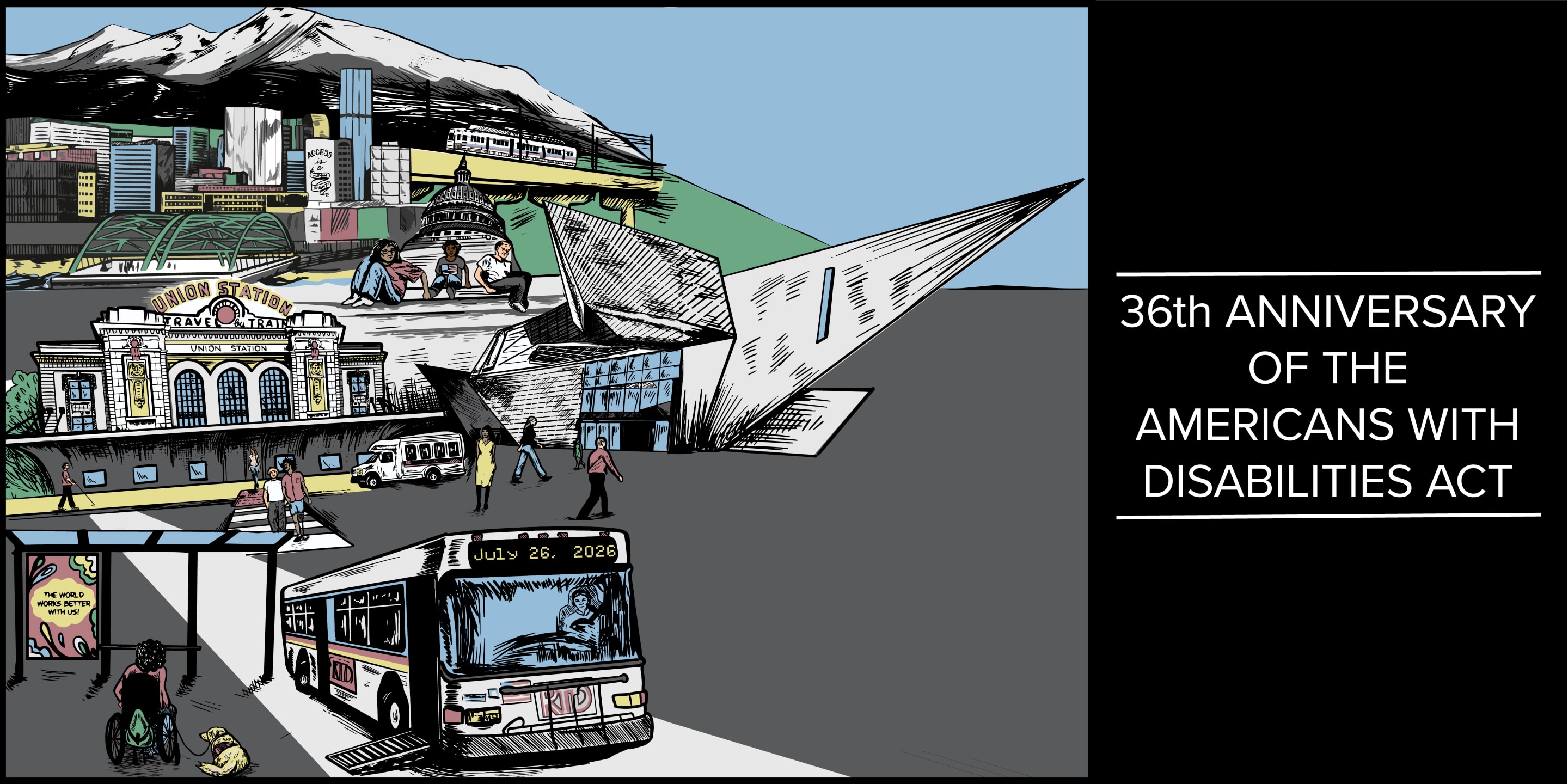
Diversity Spotlight: Honoring the 36th anniversary of the Americans with Disabilities Act and celebrating Disability Pride Month
The 2026 Disability Pride Month theme, "The World Works Better with Us," celebrates the invaluable contributions, perspectives, and leadership of people with disabilities while recognizing that communities are stronger, more innovative, and more inclusive when everyone can participate fully.
This July, RTD proudly recognizes Disability Pride Month and commemorates the 36th anniversary of the Americans with Disabilities Act of 1990 (ADA). Together, these observances celebrate the leadership, resilience, and contributions of people with disabilities while honoring the advocates whose determination transformed accessibility into a fundamental civil right.
For RTD, these observances carry particular significance. The history of disability rights is deeply connected to the history of public transportation in Colorado. As an agency committed to equitable mobility, RTD continues to build upon this legacy by advancing accessibility, strengthening community partnerships, and ensuring transportation remains accessible to all.
Why we observe
Disability Pride Month is celebrated each July in recognition of the signing of the Americans with Disabilities Act on July 26, 1990. While the ADA established comprehensive civil rights protections, Disability Pride Month celebrates disability as a natural and valuable part of human diversity. It recognizes that people with disabilities have long shaped our communities, workplaces, and society through their leadership, innovation, advocacy, and service. The observance also reminds us that accessibility is about more than compliance. It is about creating environments where every individual can participate fully, contribute their talents, and belong.
When it was signed into law by President George H. W. Bush, the Americans with Disabilities Act became one of the most significant civil rights laws in United States history. During the signing ceremony, Bush said, "Let the shameful wall of exclusion finally come tumbling down," recognizing that accessibility and equal opportunity are fundamental civil rights. The ADA prohibits discrimination against qualified individuals with disabilities in employment, public services, transportation, public accommodations, telecommunications, and other areas of public life. Its passage transformed how communities, businesses, and public agencies — including public transportation providers — design programs, facilities, technology, and services.
Today, many accessibility features that are often taken for granted — including curb ramps, elevators, accessible pedestrian signals, captioning, audio announcements, accessible websites, and low-floor transit vehicles — reflect the ADA's enduring influence.
The Gang of 19: RTD's place in disability rights history
The ADA was made possible through decades of advocacy by people with disabilities nationwide. For RTD, one of the most significant chapters of the disability rights movement unfolded here in Denver. On July 5 and 6, 1978, 19 people with disabilities, later known as the Gang of 19, organized a peaceful act of civil disobedience to protest RTD's inaccessible buses. At the time, RTD had ordered more than 200 new buses without wheelchair lifts, leaving many people with disabilities unable to travel independently to work, school, medical appointments, and other essential destinations.
The demonstration was inspired by the Rev. Wade Blank, Presbyterian minister and co-founder of Atlantis Community Inc., who introduced the group to the principles of nonviolent civil disobedience. Armed with the rallying cry "We Will Ride," the protesters blocked RTD buses at the intersection of Colfax Avenue and Broadway for nearly 24 hours, bringing national attention to the urgent need for accessible public transportation.
The demonstration became a defining moment in the disability rights movement. It prompted RTD to equip its new buses with wheelchair lifts, inspired the creation of the national grassroots organization American Disabled for Attendant Programs Today (ADAPT), and helped build momentum for the passage of the Americans with Disabilities Act 12 years later.
Today, the legacy of the Gang of 19 remains an important part of RTD's history. The group’s actions demonstrated that transportation is more than a means of travel — it is a gateway to employment, education, healthcare, civic participation, recreation, and independent living. Their courage continues to inspire RTD's commitment to building a transportation system that is accessible, equitable, and welcoming for all.
Accessibility in action at RTD
The legacy of the ADA and the disability rights movement continues to shape RTD's commitment to providing safe, accessible, and equitable public transportation for all.
Accessibility is integrated throughout RTD's transit system to help customers with disabilities travel with greater independence and confidence.Beyond physical infrastructure, RTD offers a variety of programs and services designed to support accessible travel. These include Access-a-Ride for customers whose disabilities prevent them from using the fixed-route system, reduced-fare programs for eligible customers, and accessible customer information through multiple communication formats. RTD also provides reasonable modifications to policies, practices, and procedures when appropriate to ensure customers with disabilities have equitable access to transit services.
The RTD ADA Office serves as a resource across the agency by providing technical guidance on ADA compliance, reviewing accessibility considerations for programs and initiatives, coordinating community outreach and education, and fostering partnerships with disability organizations and advocates. By listening to customers and incorporating community feedback into planning and decision-making, RTD continues to identify opportunities to strengthen accessibility, remove barriers, and enhance customer experience.
As accessibility needs and technologies continue to evolve, RTD remains committed to continuous improvement. Through collaboration, innovation, and meaningful engagement with the disability community, the agency strives to create a transportation system that connects every customer to opportunity while advancing equity, independence, and inclusion throughout the region.
Disability Pride Month events and community celebrations
RTD encourages community members to participate in local events and activities celebrating Disability Pride Month and the 36th anniversary of the ADA.
Here are several events taking place throughout the Denver metro region for community members to explore:
Resources:
The Colorado Disability Opportunity Office (CDOO) created an interactive map to explore historical landmarks and support disability-owned businesses across the state.
Events:
- Disability Pride Month Celebration at Clyfford Still Museum | 10:30 a.m.-12:30 p.m. Sunday, July 26 | Visitors are invited to participate in a free, hands-on creative activity in the museum's outdoor forecourt honoring disability pride, inclusion, and community. No registration is required.
- 504: The Musical | Aug. 6-23 | Denver Center for Performing Arts | Experience the world premiere of “504: The Musical,” a fictionalized retelling of the historic 1977 Section 504 Sit-In in San Francisco. Through music, storytelling, and powerful performances, the production celebrates the resilience, advocacy, and determination of the disability rights movement while highlighting the fight for accessibility, identity, and belonging.
Looking ahead
The Americans with Disabilities Act transformed our nation by recognizing accessibility as a fundamental civil right, but the work of creating inclusive communities continues.
RTD remains committed to strengthening community partnerships, enhancing the accessibility of its services and facilities, and providing equitable transportation that empowers every customer to travel with dignity, independence, and confidence.
Together, we can continue building a transportation system — and a community — where accessibility, inclusion, and opportunity are available to all.