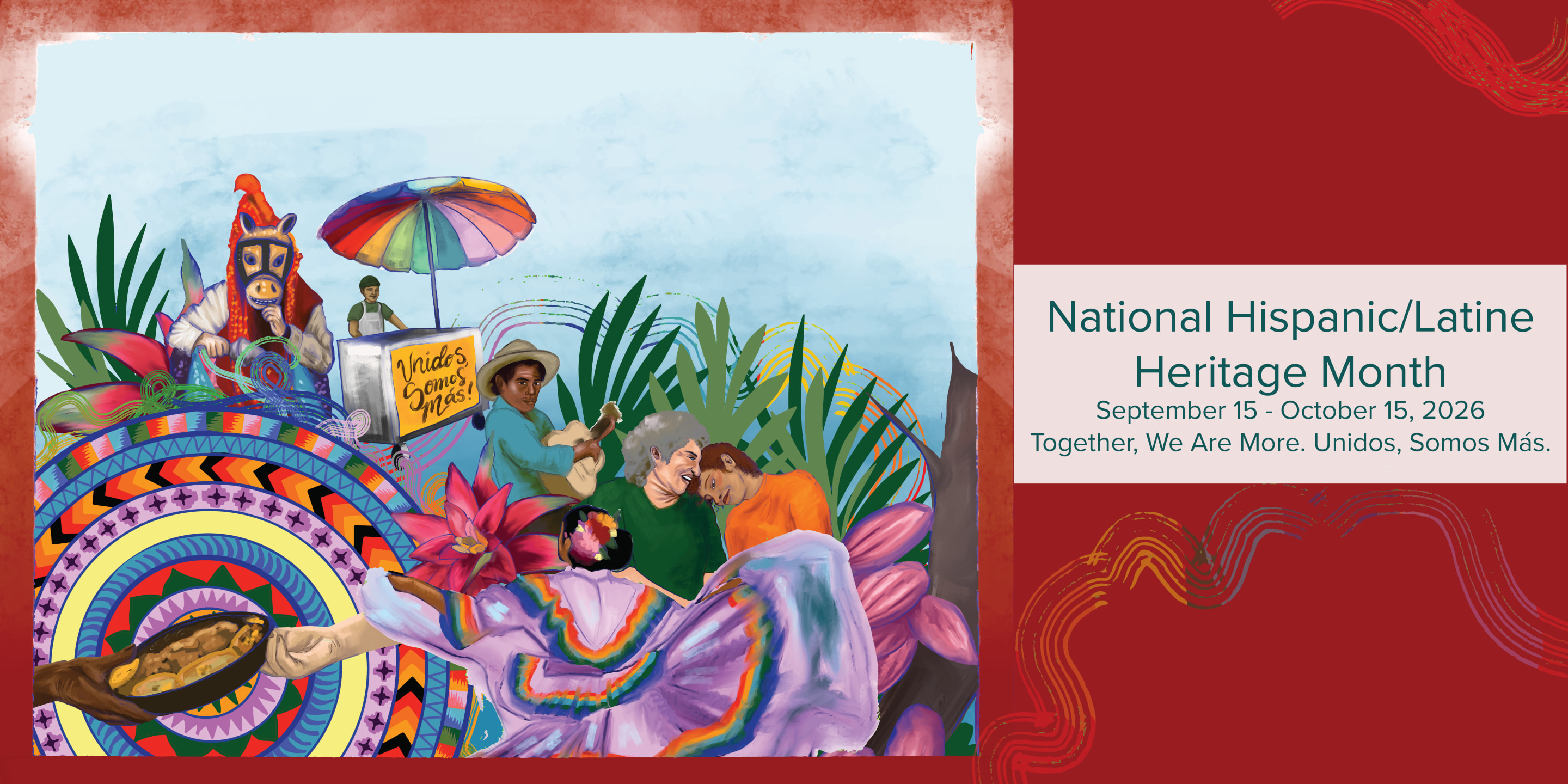
Diversity Spotlight: Together, We Are More – Unidos, Somos Más
National Hispanic/Latine Heritage Month, observed annually from Sept. 15 through Oct. 15, celebrates the histories, cultures, achievements, and contributions of Hispanic and Latine communities in the United States.
The national observance began in 1968 as Hispanic Heritage Week under President Lyndon B. Johnson. Twenty years later, Congress expanded the observance to a 30-day period, and President Ronald Reagan signed the legislation into law in 1988.
The Sept. 15 start date holds historical significance because it marks the anniversary of independence for Costa Rica, El Salvador, Guatemala, Honduras, and Nicaragua. Mexico celebrates its independence on Sept. 16, followed by Chile on Sept. 18. Together, these dates reflect some of the many national histories, cultures, and identities recognized throughout the month.
The 2026 theme, “Together, We Are More – Unidos, Somos Más,” celebrates the strength found in community and recognizes how diverse cultures, experiences, languages, traditions, and perspectives strengthen the places where we live, work, and connect.
For RTD, that connection is especially meaningful. Public transportation brings people together across neighborhoods and communities, connecting customers to employment, education, health care, small businesses, cultural experiences, family, and opportunity. Recognizing Hispanic/Latine heritage is also an opportunity to celebrate the employees, customers, community partners, business owners, advocates, allies, and leaders who help move our region forward.
A legacy of culture, community, and connection
Hispanic and Latine history in what is now the United States extends centuries before the establishment of National Hispanic/Latine Heritage Month. The communities represented by the terms Hispanic and Latine encompass a wide range of national origins, racial and ethnic identities, languages, cultures, migration experiences, and histories.
The influence of these communities is particularly significant throughout the American Southwest. Indigenous peoples have inhabited the region for thousands of years, while generations of Spanish, Mexican, and Hispano communities later established settlements, farms, ranches, trade networks, religious institutions, and cultural traditions throughout areas that now make up states such as Colorado, New Mexico, Arizona, Texas, and California.
In the Southwest, the term Hispano generally refers to people descended from Spanish-speaking communities with longstanding historical and cultural roots in the region, particularly in present-day New Mexico and southern Colorado. Many Hispano families trace their presence in the region across generations, including to communities established when the area was governed by Spain and later Mexico. Hispano identity is distinct from, while connected to, the broader Hispanic and Latine identities represented throughout the United States.
Colorado has its own deep Hispano history. San Luis, established in 1851 in the San Luis Valley, is recognized as Colorado's oldest continuously inhabited town and reflects the longstanding cultural influence of Hispano communities in the state.
Moving communities and civil rights forward
Transportation has long been connected to questions of opportunity, access, employment, and civil rights.
Across generations, Hispanic and Latine communities have utilized transportation networks to connect to jobs, schools, businesses, neighborhoods, and community life. At the same time, transportation decisions – from where infrastructure is built to who can easily access mobility – can have lasting effects on communities.
These histories remind us that mobility is about more than transportation. Being able to move safely and reliably through a community can affect a person's ability to work, learn, participate in civic life, access services, maintain relationships, and pursue opportunities.
Hispanic and Latine communities moving our region forward
Today, Hispanic and Latine communities continue to help move the Denver metro region forward—as employees, entrepreneurs, students, customers, artists, caregivers, advocates, community leaders, and transportation professionals.
At RTD, creating meaningful connections means working to ensure that customers and communities can access transportation, information, employment, contracting opportunities, and opportunities to participate in decisions that affect them.
RTD advances these connections through programs and initiatives including:
- Expanding language access. RTD’s Language Access Program provides language assistance, including interpretation and translation services, at no cost to customers. RTD also provides multilingual resources to help customers access transit information and services. These efforts support meaningful access to RTD programs and services for linguistically diverse communities.
- Making language assistance more visible. Earlier this year, RTD introduced multilingual “I Speak” buttons and Language Help decals to help customers identify employees who speak languages in addition to English and more easily access language assistance while using transit. Spanish is among the languages represented through the initiative, further supporting effective communication between employees and customers.
- Providing information and resources in Spanish. RTD provides Spanish-language information and resources to help customers better understand and access transit services, civil rights protections, and language assistance. Providing information in multiple languages can help reduce communication barriers and support meaningful access to public transportation.
Together, these efforts demonstrate that public transportation is about more than moving people between destinations. It is about strengthening connections to opportunity, reducing barriers to access, and helping ensure that the diverse communities RTD serves can participate, connect, and thrive in the community.
National Hispanic/Latine Heritage Month community events and resources
RTD encourages employees and community members to recognize National Hispanic/Latine Heritage Month by exploring the history, art, food, music, businesses, organizations, and cultural traditions of Hispanic and Latine communities throughout Colorado.
Educational opportunities and community events provide meaningful ways to learn about the diversity within Hispanic and Latine communities while recognizing the generations of people whose contributions have shaped Colorado and the nation.
Events
- Ritmo & Raíces: A Latin American Heritage Celebration | 11 a.m.-3 p.m. Sunday, Sept. 6 | Denver Union Station, 1701 Wynkoop Street, Denver, CO 80202 | RTD staff will host a table at the celebration to share transit information, answer questions, and engage with customers and community.
- Festival Latino | Noon-6 p.m. Sunday, Sept. 13 | Riverdale Regional Park, 9755 Henderson Road, Brighton | This free, family-friendly celebration of Latino culture features live music, food vendors, interactive art experiences, community resources, and activities for all ages.
- Yo soy: La lotería botánica | Sept. 13-Oct. 15 | Denver Botanic Gardens, York Street, 1007 York St., Denver | Part of Denver Botanic Gardens’ year-round Yo soy initiative celebrating Latino cultures through art, storytelling, and community connection, La lotería botánica reimagines the traditional Mexican card game Lotería through a botanical lens. The exhibition features original artwork by local artists exploring the connections among plants, culture, food, history, and community. Visitors can view a complete 54-card Lotería deck along Ming Bridge. The exhibition is included with Gardens admission.
- Noches de Arte y Voz | 7-9 p.m. Friday, Sept. 18 | CHAC Gallery & Cultural Center, 834 Santa Fe Drive, Denver | The Chicano Humanities & Arts Council will host an evening of spoken word centered on family heritage, offering an opportunity to experience Chicano arts, storytelling, and community connection.
Cultural Centers and Resources
- Museo de las Americas | 861 Santa Fe Drive, Denver | Located in Denver's Art District on Santa Fe, Museo de las Americas highlights Latino, Chicano, Indigenous, and Latin American art and culture through exhibitions, educational programming, community events, and cultural experiences.
- CHAC Gallery & Cultural Center | 834 Santa Fe Drive, Denver | The Chicano Humanities & Arts Council has celebrated Chicano, Latino, and Indigenous artistry and culture since 1978. The gallery offers exhibitions, artist programs, spoken-word events, and community programming throughout the year.
- History Colorado | 1200 Broadway, Denver | History Colorado provides exhibits, collections, educational resources, and historical interpretation exploring Colorado's Latino, Chicano, Mexican American, and Hispano histories and the communities that have shaped the state.
- Museo de las Americas Cultural First Fridays | 5-9 p.m. on select First Fridays | 861 Santa Fe Drive, Denver | Museo regularly opens its doors for Cultural First Friday programming featuring exhibitions, local artists, community activities, food, and opportunities to explore the art and cultures of the Americas.
Together, We Are More – Unidos, Somos Más
National Hispanic/Latine Heritage Month honors the distinct cultures, histories, traditions, and experiences that have shaped generations and continue to enrich our communities today.
At RTD, we recognize the Hispanic and Latine employees, customers, business owners, community partners, advocates, and families whose leadership, contributions, and perspectives help move us forward. “Together, We Are More – Unidos, Somos Más” reflects the power of connection—honoring where we come from while building a future where everyone has access to opportunity, belonging, and community.