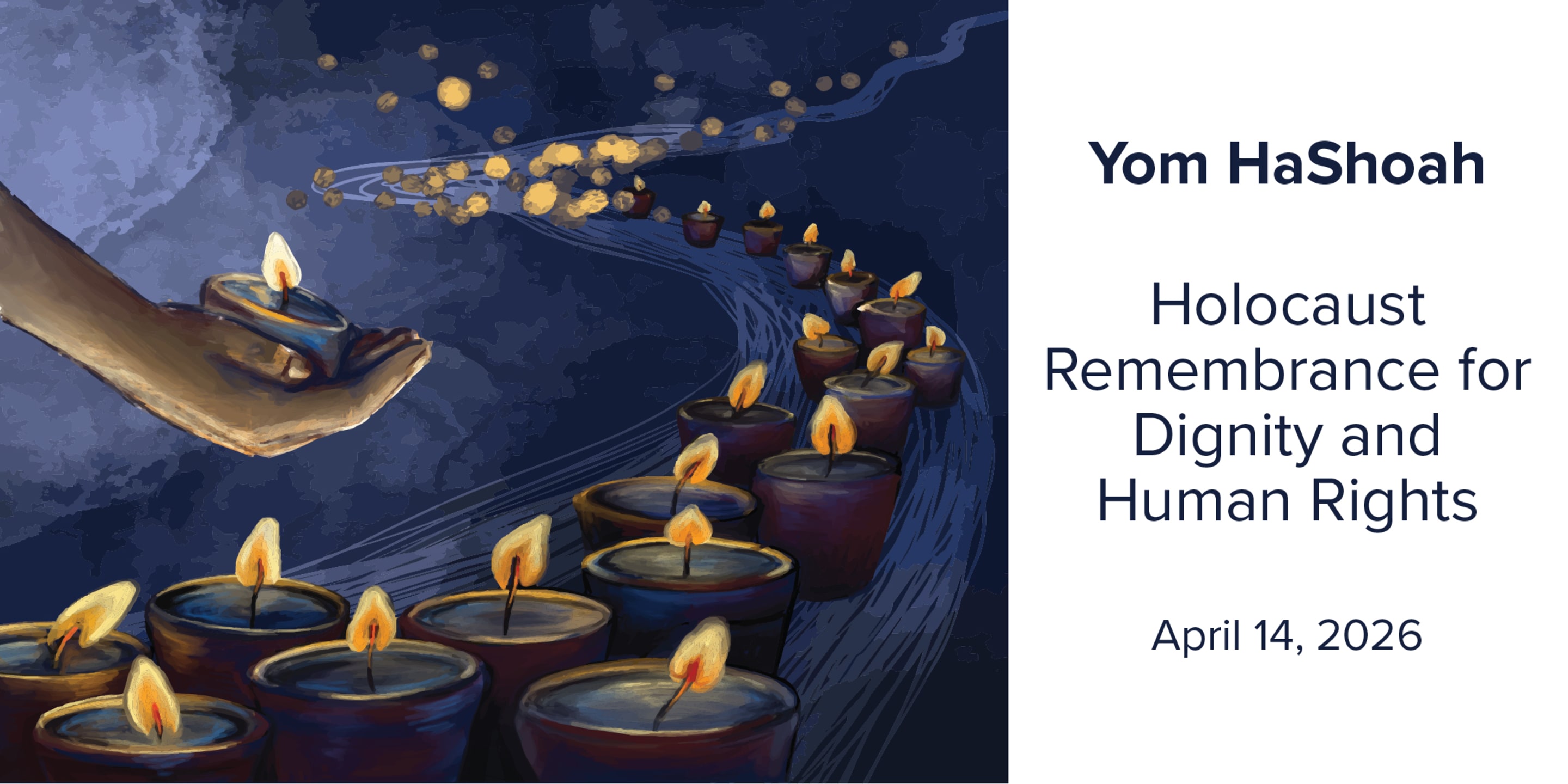
Holocaust Remembrance Day (Yom HaShoah ): Honoring memory and advancing equity through transportation
Yom HaShoah, or Holocaust Remembrance Day, is a time to honor the 6 million Jewish people killed during the Holocaust, as well as the millions of others who were persecuted under Nazi rule, including Roma and Sinti people, individuals with disabilities, LGBTQ+ people, and political dissidents. It is also a time to recognize the resilience of survivors and the enduring responsibility to uphold human dignity and justice.
Established in 1951 by Israel’s parliament, the Knesset, as Yom HaShoah Ve-HaGevurah — the Day of Remembrance of the Holocaust and Heroism — this observance intentionally centers both remembrance and courage. It uplifts not only the memory of those who were lost, but also the strength of individuals and communities who demonstrated resistance, compassion, and solidarity during one of history’s most devastating periods. Yom HaShoah is observed on the 27th day of the month of Nisan in the Hebrew calendar, with adjustments made to avoid conflict with Shabbat. Its placement aligns with the period of the Warsaw Ghetto Uprising of 1943, a lasting symbol of courage, resilience, and collective resistance. This year, Yom HaShoah is observed from sundown on Monday, April 13, through nightfall on Tuesday, April 14, following the Jewish tradition in which days begin at sunset.
In the United States, Holocaust remembrance is also recognized at the federal level. In 1980, Congress established the United States Holocaust Memorial Council, tasked with memorializing victims, promoting Holocaust education, and monitoring contemporary threats of genocide. This effort led to the creation of the annual Days of Remembrance, a week-long national commemoration observed from the Sunday before Yom HaShoah through the following Sunday. These observances reinforce a shared commitment to education, reflection, and vigilance.
Between 1933 and 1945, the Holocaust unfolded under the Nazi regime through a coordinated system of laws, policies, and infrastructure. Early measures included the Nuremberg Laws of 1935, which stripped Jewish people of citizenship and basic rights, followed by escalating violence such as Kristallnacht in 1938, when Jewish homes, businesses, and synagogues were destroyed across Germany and Austria. These events marked a transition from discrimination to widespread persecution. Efforts such as the Kindertransport (1938–1940), which helped nearly 10,000 children find safety, demonstrate how coordination, compassion, and transportation systems could be used to protect lives and create pathways to hope.
Transportation played a complex role during this time. While it was used to carry out harm, it also became, in moments of courage, a means of escape, connection, and survival. These dual realities remind us that systems are shaped by the values behind them.
Today, this history offers a powerful opportunity for reflection and growth. It calls on us to ensure that the systems — especially those that connect people and communities — are guided by equity, accessibility, and inclusion. It challenges us to build transportation networks that not only move people, but also uplift them, strengthen communities, and expand opportunity for all.
Resilience and innovation: honoring survivor contributions
Yom HaShoah is not only a time of remembrance — it is also a powerful recognition of resilience, survival, and the lasting contributions of those who rebuilt their lives and helped shape a more inclusive and equitable world.
Holocaust survivors carried with them lived experiences that deeply informed their contributions across fields such as engineering, accessibility, architecture, public service, and systems design — areas that continue to shape modern transportation and public infrastructure.
- Ralph Baer was forced to flee Nazi Germany as a child. He became a pioneering engineer whose work in electronics and systems design contributed to the evolution of modern digital technologies. These innovations underpin communication systems and emerging intelligent transportation technologies that support connectivity and efficiency today.
- Adolfo Kaminsky was a young Jewish member of the French Resistance. Heused his expertise in document forgery to produce thousands of false identity papers that enabled Jewish individuals — many of them children — to evade deportation and move safely through occupied territories. His work, carried out under immense risk, is estimated to have saved thousands of lives and stands as a powerful example of how innovation and courage can disrupt systems of oppression.
- Henry Lowenstein was a child survivor of the Kindertransport. He was among those rescued and transported to safety, an experience that shaped his lifelong commitment to advocacy, education, and public service. His story reflects the long-term impact of access to safe mobility and opportunity — demonstrating how transportation, when used to protect and connect, can change the trajectory of lives and contribute to stronger, more inclusive communities.
Together, these individuals — and countless others — demonstrate that resilience can drive innovation and that lived experience can shape systems that are more inclusive, accessible, and humane.
Commemorative events to honor Holocaust survivors
RTD encourages the community to commemorate the Holocaust and its survivors during the Days of Remembrance. Some suggestions include:
- CU Anschutz Holocaust Remembrance Week Program | 5-6 p.m. April 14 | This virtual event, titled “Why Medicine, Nazism, and the Holocaust Matters in Healthcare,” explores the historical intersections of medicine and the Holocaust, and their continued relevance in today’s health care landscape.
- Denver Holocaust Remembrance Event | 2-4 p.m. April 19 | This annual community event honors Holocaust survivors and their families, provides an opportunity to hear firsthand stories, and raises awareness around the alarming rise of antisemitism in our communities today.
- 2026 ADL Governor's Holocaust Remembrance Program | 5:30-7:15 p.m. April 26 | One of the largest Holocaust remembrance events in the United States, this annual program brings together people of all faiths to honor Holocaust survivors, remember those who perished, and educate the community while translating those lessons into contemporary action. The event has been supported by every sitting governor of Colorado since 1981. This free program includes a memorial ceremony and remarks from Gov. Jared Polis, who will also present a new Award for Excellence in Holocaust Education, recognizing an educator’s impactful work in this critical field.
Honoring the past. Moving forward together
Yom HaShoah Holocaust Remembrance Day calls us to remember not only the lives lost, but also the lessons carried forward — about the power of systems, the importance of human dignity, and the shared responsibility in shaping a more just world.
The history reminds us that transportation is more than infrastructure — it reflects values. It can be used to divide or to connect, to exclude or to expand opportunity. Today, RTD chooses to build systems that uplift.
At RTD, this commitment is demonstrated through intentional action — removing barriers, expanding access, and investing in solutions that serve all members of our community. Each innovation, partnership, and program reflects a broader purpose: ensuring that mobility is not a privilege, but a pathway to opportunity, connection, and belonging where everyone can thrive.