RTD launches apprenticeship program in bus maintenance – the first in transit in Colorado
In a bay on the maintenance floor at RTD’s Platte Division, Thomas Cervantes and Danyil Petryk work together with a quiet intensity to complete the day’s tasks, inspecting and addressing a wide range of interconnected systems on the agency’s buses, including brakes, electrical systems, and steering and suspension. But something more is happening here.
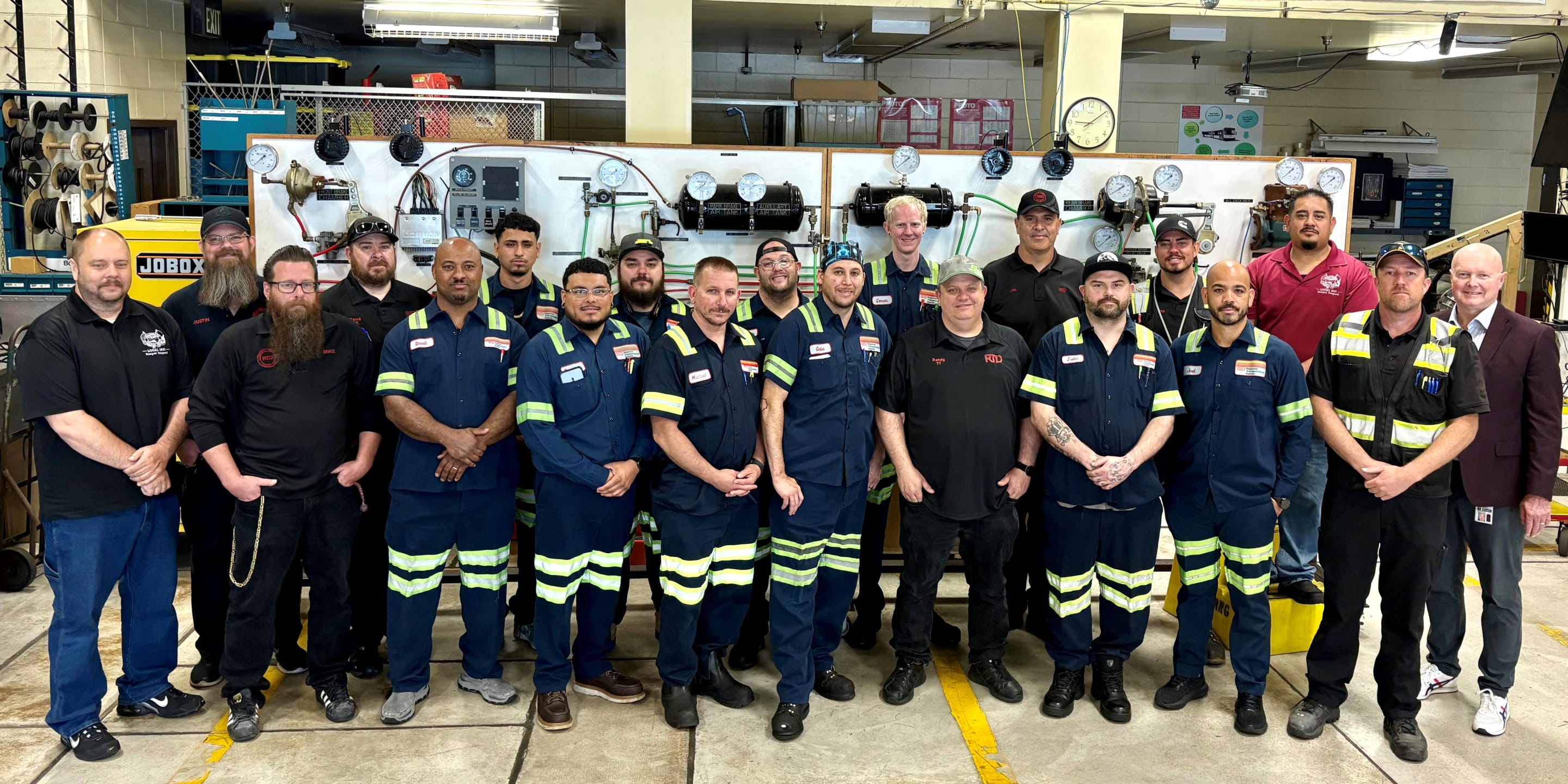
In November, these two men joined the initial cohort of RTD’s general repair mechanic apprenticeship program, an initiative four years in the making – and the first in transit in the state of Colorado. Ten mentors and five mentees have been accepted into this program, which is playing out at Platte and East Metro.
Participants choose whom they will be linked with, and they team up over an 18-month period. As apprentices work toward mastery of fundamental skills, attainment of 66 competencies in eight areas, and completion of 288 hours of classroom instruction, their wages will increase. The program provides mechanic students with consistent one-on-one instruction, coaching, and support – seen as key to training and retaining employees as a growing number of industry professionals are reaching retirement age. When they finish the program, the goal is for graduates to move into a general repair mechanic role at RTD.
“When I heard about the program, I thought it would be a good idea to be able to pass on the knowledge and the good qualities that I got from the guys over here a long time ago, to help out the new guys as much as I could,” said Cervantes, who joined RTD seven years ago and previously worked within the agency’s mechanic helper program, which apprenticeship succeeds. He and Petryk “have different personalities and different interests,” he said, “but we get along, and I think that my teaching style works with his learning style. It’s nice to be able to set the standard for what a teacher and student should be like.”
The program is the first experience working as a mechanic for Petryk, who came to the floor after 10 months in Service and Cleaning. He has been impressed thus far by the standards and expectations that have been established, as well as there being coordination for the program to oversee daily scheduling, needs, and auditing.
“I've already learned a lot from the training and the hands-on experience,” Petryk said. “And because this is the first time we're doing it, we're all figuring it out. But you can tell that everyone has an open mind, and that's the most important part, to be able to be flexible and make this thing work.”
Responsibility for apprenticeship rests both with RTD and Amalgamated Transit Union 1001, and it reflects extensive collaboration between both entities. A desire to establish this program was outlined in the collective bargaining agreement that precedes the current contract.
Apprenticeships in transit have been launched throughout the United States, noted ATU 1001 Vice President Julian Gutierrez, who conferred with locals in other cities and with ATU International leadership to gain clarity around how such programs should operate.
“There are no real trade schools that teach you how to do our jobs,” Gutierrez said. “They teach you heavy duty stuff. They teach you semi, tractor trailer stuff. But they don't teach you transit. We’re really having to build our own, which we’ve kind of already done with the mechanic helper program.” Referencing that approach, he said, “We didn't have to reinvent the wheel. It just needed a little bit more fine tuning.”
Apprenticeship provides the same instruction as was given during RTD’s mechanic helper program, but with more structure and focused attention. The learning students receive is similar to the automotive-specific instruction offered at local trade and technical schools, noted Technical Training Manager Dave Plumisto, who has served on committees at these institutions.
“Being dedicated to work with somebody, and knowing where they're working and what they're working on, is a great value to both members that are on the floor, so they can develop a relationship and know what things are happening,” Plumisto said. “And it's going to get to the point where the mentor is going to step back, and the mentee is going to take over.”
Adding less-skilled colleagues to the floor initially requires patience, recognizing that some tasks will take longer to complete as these colleagues acquire the education and skills needed to do the work properly. Plumisto’s team has had to determine how to introduce additional hours and areas of instruction to accommodate them. These tension points arise amid an operational reality that requires meeting daily schedules and deploying agency services, acknowledged Sangman Yoon, General Superintendent of Maintenance for Bus Operations.
“We have to look beyond what's going to be negative impact today, to what's going to give down the road,” Yoon said, noting that the agency must actively develop and recruit for the jobs it needs. “Apprenticeship fits in perfectly, filling the gap.”
“Education and training always take time to yield the fruits,” he added. “There may be less productively for, say, one year or two years, but they may give you the next 30 years.”
Being able to train for a new career path while being paid full time with benefits doesn’t happen just anywhere or in any role, observed Learning and Training Specialist Allison Korinek, who serves on RTD’s Workforce Development Committee and helped develop the curriculum for the mentor training. While apprenticeship is open at this point just to current agency employees, she said, circulating word about the program can show local students that transit is a viable career path.
“If we can start connecting the dots for the educational network on the Front Range, and for those prospective workers that we're trying to reach through career fairs and other venues,” Korinek said, “the possibilities are kind of endless to make all that come together.”
Korinek pointed out that licensing of the program at the state and federal levels opens it to grant opportunities and additional enrichment, and she noted the consistent support provided by ATU International leadership. The union’s Director of Apprenticeships and Workforce Development, Jamaine Gibson, and Workforce Development Coordinator Eliseo Acosta have remained incredibly supportive, she said.
“They put us in touch with coordinators and Workforce Development Committee equivalents at other transit agencies,” Korinek said. “They have been with us every step of the way.”
Acosta has assisted with the launch of RTD’s apprenticeship program and many others across the United States. ATU International has trained more than 2,400 mentors, he said.
Acosta said he is impressed by the scheduling, support, and structure he has observed to this point at RTD. In the meetings he sat in on, Acosta said, “what struck me was the collaboration between labor and management and how they're both on board to see this succeed, and to see these individuals climb, which was pretty incredible.”
Personally and professionally, Acosta added, “I have seen the benefits. I'm a product of apprenticeship. And when you have somebody to guide you, it reduces the anxiety, it reduces the fears of doing something new, because it is life-changing.” Completing such a program, he said, instills pride and confidence to pursue new challenges and growth.
Beyond bus maintenance, there is interest across RTD in introducing apprenticeships in other areas. A related hope for this new program is that the structure that has been developed could become a blueprint for others to learn from.
“I think apprenticeship changes the dynamic of the workplace, in that it supports people in having a career, and particularly the connection with others,” said Kent Enwright, RTD’s Employee and Labor Relations Director. “I think it's an evolution to a higher skilled workforce, a more satisfied workforce, and in that context, one that has less turnover.
“You want to raise the level of everybody,” Enwright said, “and I think this is one of those tools to do it and build some loyalty to the organization.”
Petryk, one of the first mentees at Platte, is encouraged to see the support for the program at all levels of the agency. The buy-in from everyone from his peers in the shop to higher levels of leadership gives him confidence in his work that extends beyond the daily tasks he is assigned.
“I think that it's going to be really beneficial for the company in the long term,” Petryk said. “And I think that it's going to be something that we're going to continue doing.”