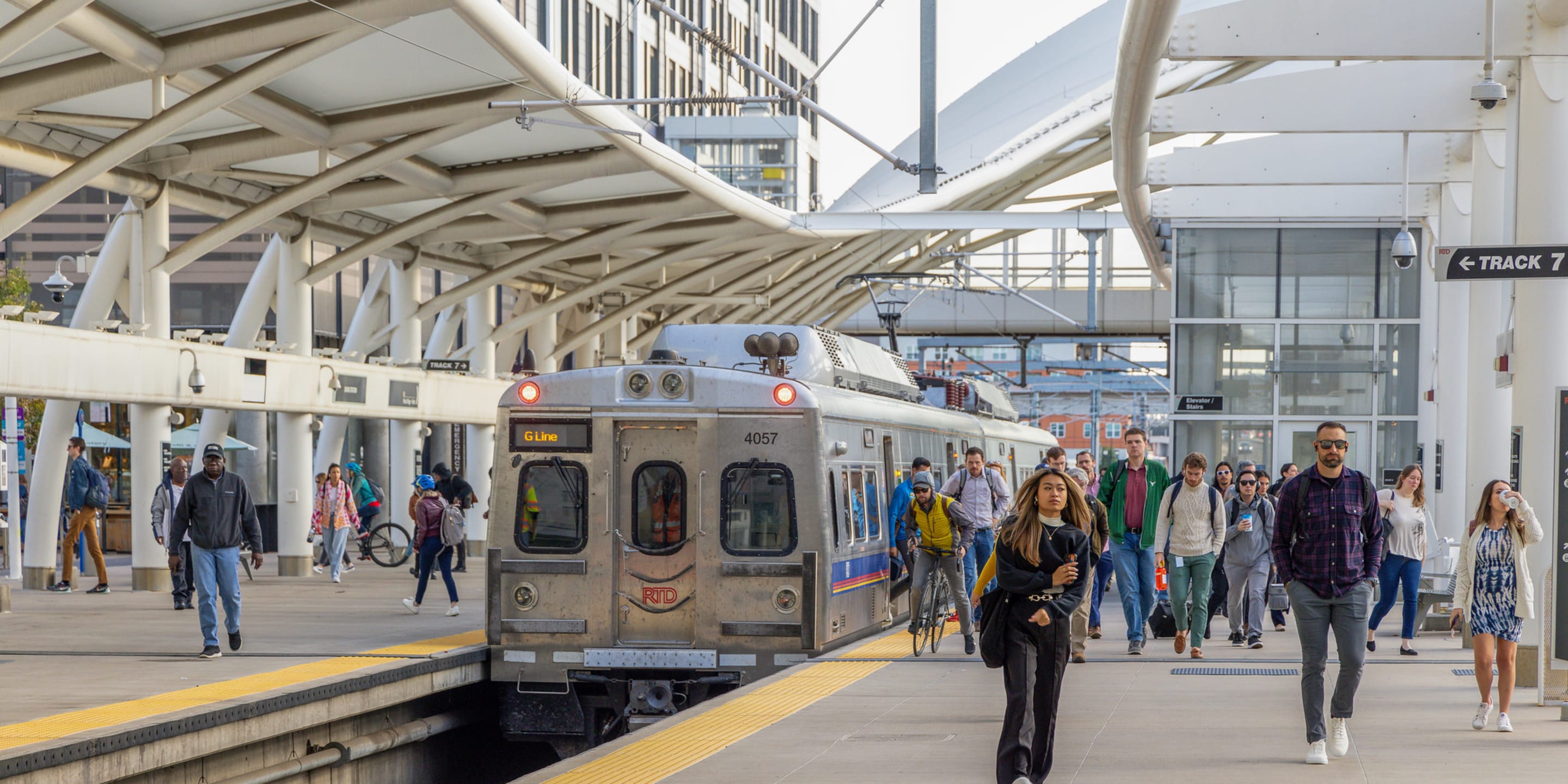
RTD’s proposed June service changes would increase frequencies and introduce new rail connections
Agency plans to reinstate the C Line, add the T Line, and increase frequencies on the B and G lines to bolster mobility options across the region
DENVER (March 9, 2026) –– The Regional Transportation District (RTD)’s Operations, Safety, and Security Committee will take action on Wednesday, March 11, to consider moving forward several service changes that would introduce new connections, increase bus and train frequencies, and improve schedules. The June 2026 Service Changes were first publicly introduced last month, with many of the adjustments being proposed to support the next phase of the agency’s multi-year Downtown Rail Reconstruction Project. If RTD’s committee votes to move the service changes forward on Wednesday, the service changes will then go to the full Board for its consideration on March 24.
“At a time when the agency is keenly focused on optimizing its resources and services to best support customers, these proposed changes introduce several new mobility options and enhance regional connections,” said Debra A. Johnson, RTD General Manager and CEO. “The increased frequencies and improvements are the result of RTD receiving additional transit funding from the State of Colorado, as well as the agency’s staff exploring ways to optimize resources.”
RTD applied to Colorado’s Clean Transit Enterprise (CTE) grant program and was awarded $9.25 million to use in 2026. The grant program stipulates that RTD use the funding to increase frequencies, expand hours of service, or augment connections. The CTE grant is funded through oil and gas production fees, and it is annually available to transit agencies across the state.
The proposed June service changes introduce a temporary T Line along the Southeast Corridor, reinstate the C Line to Denver Union Station, extend the R Line to RidgeGate Parkway Station, increase train frequencies on the B and G lines, and improve service across 12 bus routes. Many of RTD’s proposed service changes were developed to provide customers with alternative connections during the next phase of the Downtown Rail Reconstruction Project.
T Line to be introduced
If approved by the Board, the T (Temporary) Line would operate from Lincoln Station to I-25•Broadway Station, replacing some services currently offered between I-25 and Southmoor stations via the H Line. The H Line will be temporarily suspended when the Downtown Rail Reconstruction Project starts in June. The T Line will run at regular intervals, including service every 15 minutes on weekdays, between 6 a.m. and 6 p.m.; every 30 minutes between 6 p.m. and midnight, Sundays through Thursdays; and until 2 a.m. on Saturdays. The full proposed schedule information is available online.
C Line to be reinstated
The C Line, which was previously discontinued in January 2023, is being proposed for reinstatement to provide downtown connections for customers along the Southwest Corridor. The C Line will connect Littleton•Mineral Station and Denver Union Station and is being offered while the D Line is suspended due to the Downtown Rail Reconstruction Project. RTD can offer C Line service on tracks adjacent to the D Line that are not impacted by the upcoming rail work.
R Line service extended
June’s proposed service changes include extending the R Line farther south, from its current terminal at Lincoln Station, to RidgeGate Parkway Station and increasing frequency to 15-minutes from 30-minutes 6 a.m.-6 p.m. on weekdays and 9 a.m. -6 p.m. on weekends. The extension to the end of the line will provide customers with access to three additional stations, including SkyRidge, Lone Tree, and RidgeGate Parkway.
G Line and B Line frequencies doubled
Service frequencies on the G Line, which connects Wheat Ridge•Ward Road Station with Denver Union Station, will be restored to 15 minutes on weekdays between 6 a.m. and 9 p.m., and on Saturdays, Sundays, and holidays between 8 a.m. and 6 p.m. Currently, the G Line runs in and out of downtown every 30 minutes. Similarly, Westminster’s B Line frequencies will be restored to 30 minutes – up from one-hour service – on weekdays 6-9 a.m. and 3-6 p.m.
The proposed service increases during peak travel times on two of RTD’s commuter rail lines come at no additional cost to the agency and will better support a growing customer demand. In 2020, the agency reduced many of its bus and rail services to better align resources with customer utilization during the COVID-19 pandemic. Services on the A, B, and G lines, which are operated by Denver Transit Partners (DTP), RTD’s commuter rail concessionaire, were included in those service adjustments. In April 2020, RTD reduced service levels across its system due to operator shortages and less transit utilization across the system at that time. Subsequently, RTD asked DTP to move train cars from the B and G lines to bolster A Line service and align with customer utilization between Denver Union Station and the airport, and DTP began running four-car trains on January 20, 2024. During the COVID-19 pandemic, ridership on the A Line remained fairly consistent and, according to a report published last year, led the nation in utilization and revenue hours.
To support growing customer demand and forecasted utilization, RTD provided notice to DTP to internally reallocate resources across all commuter rail lines and resume the 30-minute and 15-minute frequencies on the B and G lines, respectively, beginning in June. The no-cost frequency increases on the B and G lines are possible due to how internal resources are allocated, including expenses associated with the length of trains and other operating and maintenance costs. RTD regularly meets with DTP to examine service levels and ensure resources are appropriately allocated to meet customer demand.
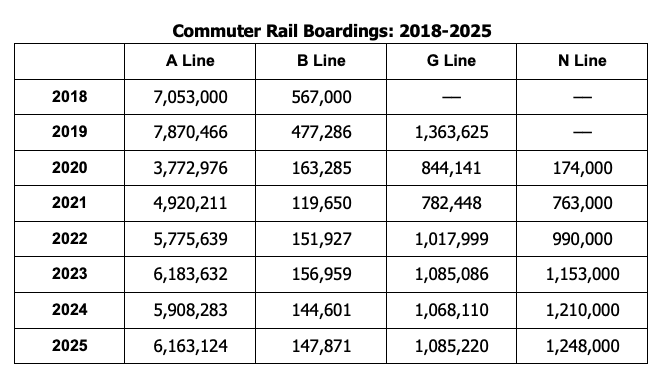
Click here to download the boardings/ridership data.
Bus service levels increased and improved
Twelve bus routes are proposed for service improvements, including the 0L, 10, 16th Street FreeRide, 19, 21, 37, 43, 53, 80, 104L, ART, and 287. If approved by the Board later this month, the FreeRide would operate every three minutes from its current four-and-a-half-minute frequency, and routes 0L and 43 would see midday service increases, operating every seven-and-a-half minutes. The changes were proposed to provide service options and maintain connections during the downtown rail project. The 104L would be adjusted to arrive five minutes earlier on weekends for better connections to the N Line and add a daily eastbound and westbound trip.
March 24 Board meeting
If approved by the Board during its March 24 meeting, the June service changes will take effect on Sunday, June 7. RTD regularly monitors its system and proposed adjusts three times a year, typically in January, May/June, and August/September. The service changes support a variety of factors, including customer demand, seasonal adjustments, work-shift selections by frontline personnel, maintenance projects, and customer feedback.
To review the complete list of the proposed service changes, visit the Service Changes webpage. RTD also encourages customers to use the Next Ride app to plan for any travel adjustments from bus routes and rail lines affected by the service changes. Customers can keep up to date on service changes by signing up for Service Alerts.